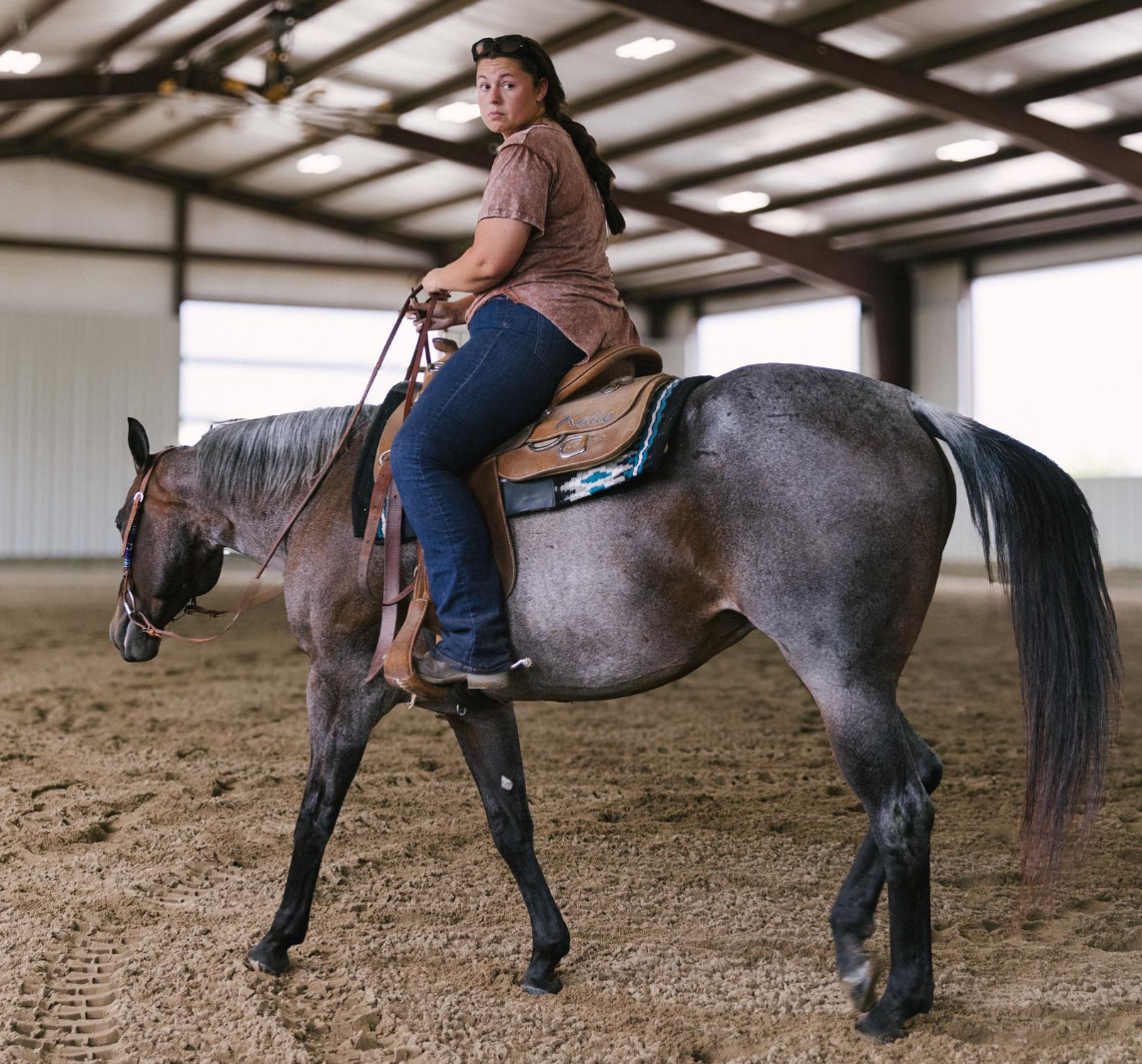
I show AQHA Quarter Horses in Western pleasure and horsemanship, and I ride every gait in this guide on our horses at Running Springs in Nolensville, Tennessee.
I'm Katie Van Slyke, and I breed and show AQHA Quarter Horses at Running Springs, our farm in Nolensville, Tennessee. I ride Western and show in the jog and lope myself, so these aren't textbook definitions to me, they're what I feel in the saddle and watch judged in the show pen every season.
Welcome to a new educational series with Katie Van Slyke. This series will introduce important horse terminology, the words and concepts that come up in everyday riding, training, horse showing, and even horse breeding.
If you've ever heard terms like jog, lope, or pivot and wondered what they meant, this guide will help clarify the basics. If you're brand new to the equestrian world, start with our guide to what to expect your first time riding a horse.
Let's talk about the foundational horse gaits: walk, trot, jog, lope, and canter. Understanding these movements is essential for any rider, whether enjoying casual trail rides or stepping into the show arena.
Key Takeaways
- The basic horse gaits progress from walk to trot, canter, and gallop, with Western riders often saying jog and lope.
- Walk has four beats, trot or jog has two, canter or lope has three, and gallop is the fastest four-beat gait.
- Lope and canter describe the same basic three-beat gait, but lope usually refers to a slower, more collected Western version.
- Leads matter in the lope, canter, and gallop because the leading foreleg affects balance through turns.
What's In Here
- Horse Gaits List at a Glance
- The Walk
- The Trot
- The Jog
- The Lope
- The Canter
- The Gallop
- Backing Up (The Rein-Back)
- How Many Gaits Does a Horse Have?
- What About Gaited Horses?
- Essential Riding Cues and Movements
- What Is a Lead (and a Lead Change)?
- Why These Terms Matter
- Looking Ahead
- Meet the Herd at Running Springs
- Final Thoughts
- Frequently Asked Questions About Horse Gaits
Horse Gaits List at a Glance
| Horse gait | Beat pattern | Common Western term | How it looks |
|---|---|---|---|
| Walk | Four beat | Walk | Each hoof lands separately |
| Trot | Two beat | Jog when performed more slowly | Diagonal pairs move together |
| Canter | Three beat | Lope | Rolling stride with a moment of suspension |
| Gallop | Four beat | Gallop | Fastest gait with a longer suspension phase |
Horse movement is easiest to identify by listening for the beat pattern and watching which legs land together. Speed can vary within a gait, so a faster trot does not automatically become a canter, and a fast canter is not always a full gallop.
The Walk
Watch how each hoof strikes the ground independently in the horse's four-beat walk.
The walk is the most basic and relaxed gait. It's a four-beat gait, which means each hoof hits the ground independently in a clear sequence. No two feet strike at the same time.
The walk is steady, even, and natural for all horses. It looks the same whether the horse is in Western or English tack. The main difference lies in the riding discipline rather than the gait itself.
Here's what that four-beat pattern looks like, step by step:
- Right hind
- Right front
- Left hind
- Left front
Each hind leg moves first, then the front leg on the same side follows. That lateral pattern is what gives the walk its smooth, even rhythm, and it's the only standard gait where at least one hoof is always on the ground.
Pro tip
You'll hear the term "moment of suspension" a lot in the faster gaits below. It means there's an instant in every stride where all four hooves are off the ground at the same time. The walk never has one, which is part of why it feels so stable under the rider. Every other standard gait does.
The Trot
This animation breaks down the trot's diagonal footfall pattern so you can see exactly how a horse moves at this two-beat gait.
The trot is a two-beat gait, where the horse's diagonal legs move together. For example, the front right and back left land at the same time, followed by the front left and back right.
At the trot, riders often use a technique called posting, which involves rising and sitting in rhythm with each stride.
Posting makes the motion smoother and helps conserve energy over longer distances. The trot is naturally more forward-moving than the walk, covering more ground with each stride.
Here's the diagonal footfall pattern:
- Right hind and left front land together
- Left hind and right front land together
Between those two beats, there's a brief moment of suspension where all four hooves are in the air. That airborne instant is what creates the bounce that makes the trot harder to sit than the walk.
The Jog
See how the jog keeps the same diagonal footfall as the trot but at a slower, flatter, and smoother pace.
The jog is also a two-beat gait, but slower, flatter, and more relaxed than the trot. The same diagonal leg pairs move together, yet the movement is less bouncy and more controlled.
In horse showing, especially Western disciplines like Western pleasure, the jog is highly valued for its smoothness and steadiness. It's often described as the "Western version" of the trot, designed to be comfortable and sustainable for both horse and rider.
The footfall pattern is identical to the trot, just at a slower tempo with less suspension. That reduced bounce is exactly why Western riders can sit the jog comfortably without posting.
The Lope
The lope is a three-beat gait commonly seen in Western riding. It's a slower, more collected version of the canter.
The pattern of movement begins with one hind foot, then the opposite hind and diagonal front land together, followed by the leading front leg. This creates three beats, along with a moment of suspension where all four hooves are off the ground.
In Western horse showing, the lope is an important gait for classes like Western pleasure and horsemanship. It reflects balance, control, and smoothness rather than speed.
I actually go into more detail about what a day of Western pleasure looks like with Denver in a separate post.
Here's what the three-beat footfall looks like on each lead:
Left lead lope
- Right hind
- Left hind and right front together
- Left front (the leading leg)
Right lead lope
- Left hind
- Right hind and left front together
- Right front (the leading leg)
The leading front leg is always the last one to strike the ground before the moment of suspension. That's why it's called the "lead," and I'll explain why it matters in the leads section below.
The Canter
This video explains how the horse moves at the canter and what you actually feel as a rider, including the rocking-horse motion most people find easier to sit than the trot.
The canter is the English counterpart to the lope. Although mechanically the same three-beat gait, the canter typically involves longer strides, more energy, and more forward momentum. It's common in disciplines such as hunter under saddle, dressage, and jumping.
While the lope emphasizes relaxation and control, the canter highlights athleticism and reach, making it a cornerstone gait in English horse showing events. For a closer look at how to identify which lead a horse is on at the canter, check out our guide to measuring a horse and identifying canter leads.
The footfall sequence is the same as the lope listed above, just with more forward reach in each stride and a longer moment of suspension.
The Gallop
Watch a horse gallop in slow motion.
There's one more natural gait, and it's the big one: the gallop. The gallop is a horse's fastest way of moving, and here's the part that surprises people. It isn't just a faster canter.
Where the canter and lope are three-beat gaits, the gallop is a four-beat gait, with each hoof striking the ground separately and a moment of suspension where all four feet are off the ground at once.
This is the gait you see on the racetrack, and it's where my breed gets bragging rights. The American Quarter Horse is the fastest horse in the world over a quarter mile, which is literally where the "Quarter" in the name comes from, and Quarter Horses have been clocked sprinting up to around 55 miles per hour.
For comparison, an average horse's gallop is closer to 27 miles per hour. We also keep a couple of off-the-track Thoroughbreds here at Running Springs, and honestly, nothing beats watching one of our babies open up and gallop across the pasture for the very first time.
Just like the canter and lope, the gallop travels on a right or left lead, which is one of the terms I get asked about most. I'll come back to leads in a minute.
Here's how the four-beat footfall breaks down on each lead:
Left lead gallop
- Right hind
- Left hind
- Right front
- Left front (the leading leg)
Right lead gallop
- Left hind
- Right hind
- Left front
- Right front (the leading leg)
Notice how the canter's diagonal pair splits apart at the gallop. That extra separation between the hind and front legs on the same diagonal is what turns three beats into four, and it's what lets the horse cover so much more ground at full speed.
Backing Up (The Rein-Back)
There's one more natural movement worth knowing, and if you've ever watched a reining class, you've seen it in action. Backing up is a two-beat diagonal gait with the same footfall pattern as the trot, just in reverse.
The horse picks up and sets down its feet in diagonal pairs, stepping straight backward:
- Right front and left hind move together
- Left front and right hind move together
In reining competitions, the backup is a required maneuver that judges score on straightness and willingness. In dressage, the same movement is called a rein-back. Either way, the horse should stay straight and step back smoothly without rushing or resisting.
I've been working on my reining foundations at Pond Hill, and the backup is one of those maneuvers that looks simple until you try to keep your horse perfectly straight through it. Horses don't naturally want to travel backward for more than a few steps, so a smooth, willing rein-back takes real training.
How Many Gaits Does a Horse Have?
So how many gaits does a horse actually have? Most horses have four natural gaits, the ones they'll do on their own without any special training: the walk, the trot, the canter (or lope), and the gallop.
Some references also count backing up as its own gait. A handful of breeds, called gaited horses, have extra smooth four-beat gaits like the running walk, but that's a different world from the stock horses we ride and show here.
If you're curious about some of the smaller horses in our barn, I wrote about mini horses and their big potential, and you might be surprised at how differently their gaits look at their size.
Because Western and English riders often use different words for the exact same movement, here's how they line up side by side:
| Gait (slow to fast) | Beats | Western term | English term | What it feels like |
|---|---|---|---|---|
| Walk | 4 | Walk | Walk | Slow and even, each hoof landing on its own |
| Trot / Jog | 2 | Jog | Trot | Diagonal pairs together; the jog is slower and flatter |
| Canter / Lope | 3 | Lope | Canter | Rolling three-beat with a moment of suspension; the lope is slower and more collected |
| Gallop | 4 | Gallop | Gallop | Fastest gait, four separate beats and full suspension |
If you want the broader barn vocabulary beyond movement, from tack to color to breeding words, I put together a full rundown of horse terms for beginners in a separate guide.
And if breeding terminology is what you're after, our horse breeding terms and lingo guide covers everything from sire and dam to live cover and AI.
What About Gaited Horses?
I mentioned gaited horses above, and while they're a completely different world from the Quarter Horses I ride, they're worth understanding if you want the full picture of how horses move.
Gaited horses are breeds that naturally perform smooth, four-beat intermediate gaits instead of (or in addition to) the standard trot. These gaits go by different names depending on the breed: the running walk in Tennessee Walking Horses, the tölt in Icelandic Horses, the paso fino in Paso Finos, and the rack in American Saddlebreds.
What makes these gaits feel different from the trot is that most of them keep at least one hoof on the ground at all times, with no moment of suspension. That constant ground contact is what makes gaited horses so smooth to ride, especially over long distances or uneven terrain.
| Breed | Signature gait | What makes it distinct |
|---|---|---|
| Tennessee Walking Horse | Running walk | Long overstep, deep head nod, very smooth |
| Icelandic Horse | Tölt | Adjustable speed, no suspension, fluid movement |
| Paso Fino | Paso fino (fino clásico) | Extremely rapid, short strides, highly collected |
| Missouri Fox Trotter | Fox trot | Slight front-to-back rock, low impact on the rider |
| American Saddlebred | Rack / slow gait | Animated, elevated front end, flashy |
The science behind these gaits comes down to genetics. Researchers identified a mutation in the DMRT3 gene, sometimes called the "Gait keeper" gene, that controls how the spinal cord coordinates limb movement.
Horses that carry this mutation can perform lateral and ambling gaits that standard-gaited horses cannot. A 2012 study published in Nature traced the mutation across gaited breeds worldwide, from Icelandic Horses that have been isolated for over a thousand years to Tennessee Walking Horses developed in the American South.
Our Quarter Horses don't carry the DMRT3 mutation, which is why they do the standard walk, jog, lope, and gallop that you saw in the sections above. Different tool for a different job.
Essential Riding Cues and Movements
Beyond the basic gaits, a few other terms are helpful for anyone learning horse terminology:
"Whoa": A cue that means stop. Regardless of the gait, walk, trot, jog, lope, or canter, "whoa" signals the horse to halt immediately. In English disciplines, the same action is often called a "halt."
Pivoting: A maneuver where the horse rotates around a planted foot. In a hindquarter pivot, one hind foot stays still while the front end moves in a circle.
In a forehand pivot, the front end remains planted as the hindquarters swing around. These movements are essential in many Western events and demonstrate precision and control.
What Is a Lead (and a Lead Change)?
This is the "leads" I promised to come back to, and it's one of the most useful things to understand once you're comfortable at the lope or canter.
At the lope, canter, and gallop, a horse travels on a lead, meaning one front leg reaches farther forward than the other. On a left lead, the left front leg leads; on a right lead, the right front leads.
Which lead the horse is on actually matters. A horse should be on the inside lead for the direction it's traveling, so it stays balanced through turns and circles. When it's on the other one, we call it the wrong lead, or a counter canter when it's done on purpose at higher levels as a balance exercise.
When a horse switches from one lead to the other, that's a lead change.
A simple change drops down to a walk or jog for a stride and picks the new lead back up.
A flying change swaps leads in the air in a single stride without ever breaking gait, and the moment of suspension is exactly when a rider asks for it.
In the show pen, being on the correct lead and making clean lead changes is a big part of what a judge is watching for, so this is one of those terms worth knowing cold. I break this down even further in our canter leads guide.
Why These Terms Matter
These gaits and movements aren't just vocabulary, they are the building blocks of horsemanship. They connect directly to training, performance, and evaluation in the horse world.
In horse breeding, a horse's natural movement at the walk, trot, or canter can influence breeding decisions and the desirability of certain bloodlines.
If you're curious about what goes into those decisions, I share behind-the-scenes updates in our broodmare bump date update and our 2026 foaling season preview.
In horse showing, judges look closely at how well each gait is performed, considering rhythm, balance, and correctness.
For everyday riders, understanding the difference between a jog and trot or a lope and canter can make riding smoother, safer, and more enjoyable.
Looking Ahead
This introduction to basic gaits is just the start. Future topics in the series will explore horse anatomy, tack, grooming terms, and more advanced riding concepts.
From learning about "leads" in the canter to understanding conformation terminology used in horse breeding, there's a wide world of knowledge to uncover.
Suggestions from the community are encouraged, making the series interactive and tailored to the terms riders and horse lovers most want explained.
Meet the Herd at Running Springs
Everything in this guide is part of my everyday life at Running Springs, our Quarter Horse and cattle farm in Nolensville, Tennessee, where I breed and show AQHA Quarter Horses and stand two stallions, VS Code Red (Waylon) and First Thingz First (Denver).
You can learn more about me on my About Me page, and I answer the questions I hear most in our FAQ.
Come follow along for the daily barn life on Facebook, Instagram, TikTok, and YouTube.
Final Thoughts
This series with Katie Van Slyke aims to make horse terminology simple, practical, and accessible for everyone. Whether the goal is excelling in horse showing, making informed decisions in horse breeding, or simply enjoying time in the saddle, understanding the basics of horse movement is the perfect place to start.
And if you want even more fun horse facts you probably didn't know, that's a great next read.
Frequently Asked Questions About Horse Gaits
How many gaits does a horse have?
Most horses have four natural gaits they'll do on their own: the walk, the trot, the canter (called a lope in Western riding), and the gallop. Some references also count backing up as a gait, and certain gaited breeds have extra smooth four-beat gaits like the running walk.
What is the difference between a lope and a canter?
They're mechanically the same three-beat gait. "Lope" is the Western word for it and is slower, flatter, and more collected, while "canter" is the English word and usually has longer, more forward strides. I ride and show the lope in Western pleasure.
What is the difference between a jog and a trot?
Both are two-beat gaits where the horse's diagonal legs move together. The jog is the Western version, slower and flatter so it's easy to sit, while the trot is more forward and often ridden with posting in English disciplines.
Is the gallop a gait, and how fast is it?
Yes, the gallop is its own gait, and it's the fastest one. Unlike the three-beat canter, it's a four-beat gait with a moment of suspension. An average horse gallops around 27 mph, but Quarter Horses, the breed we raise, are the fastest in the world over a quarter mile and have been clocked up to about 55 mph.
What is a lead in horseback riding?
At the lope, canter, or gallop, the horse's lead is whichever front leg reaches farther forward. A horse should be on the inside lead for the direction it's traveling so it stays balanced. Switching leads is called a lead change, either a simple change through a walk or jog, or a flying change done in a single stride.
What is the fastest horse gait?
The gallop is the fastest gait, built for covering ground quickly with a full moment of suspension in every stride. It's the gait you see on the racetrack, and it's where Quarter Horses shine as the fastest sprinters in the horse world.
What are gaited horses and how are they different from Quarter Horses?
Gaited horses are breeds like Tennessee Walking Horses, Icelandic Horses, and Paso Finos that naturally perform smooth four-beat gaits instead of the standard trot. These gaits keep at least one hoof on the ground at all times, making them very smooth to ride. The difference comes from a mutation in the DMRT3 gene that changes how the spinal cord coordinates leg movement. Quarter Horses like ours don't carry this mutation, so they perform the standard walk, jog, lope, and gallop.
About the Author

Hi, I am Katie Van Slyke!
I breed AQHA Quarter Horses at my family farm in Tennessee, stand two stallions, and document foaling season every year from the barn floor while sharing the daily realities of farm life.
I am incredibly lucky to share this journey with millions of friends across YouTube, TikTok, Facebook, and Instagram. You can read the full story of how it all started on my about page.
Sources
- Montana State University Extension: Equine Locomotion and Gaits
- Ohio State University Extension / Ohio 4-H: Horse Gaits
- American Quarter Horse Association: Racing World Records
- Horse&Rider: Fastest Recorded Horse Speeds
- Michigan State University / My Horse University: Natural and Artificial Gaits of the Horse
- Andersson et al., "Mutations in DMRT3 affect locomotion in horses and spinal circuit function in mice," Nature (2012)
- UC Davis Veterinary Genetics Laboratory: SynchroGait (DMRT3) Test
Keep Reading













1 comment
HELLO KATIE
You have opened my eyes to Western Riding. My own experience in Canada is English riding (Hunter/Jumpers) 1960’s , 70’s and early 80’s. At that time the show ring was dominated by Off The Track Thoroughbreds. To this day I have a soft spot for the breed. I moved to Sweden for ‘love’. In Sweden, riding horses is the second largest sport. The government finally realized an unfair disproportion of funding was directed to boys in sports. To even out the score, more funding was directed to riding schools and riding associations. My daughter after riding Cross Country, Jumping, settled down to her love of riding Dressage. This took her on a journey from Sweden to Denmark, Germany and then back home.
Sorry for the long introduction.
Your face book entries to the Quarter Horse Shows opened my eyes to another world.
Your horses are beautiful.
I am fascinated on their slow movements and low body frame.
Also how calm they are at shows, to me it seems like they are just about to take a snooze. The last statement was not a criticism, just wonderment.
Thank you for introducing your world and opening my eyes to the beauty of Quarter Horses.
Keep showing your enthusiasm and passion to the rest of the world.
Sincerely yours
CLAUDIA THAMS