
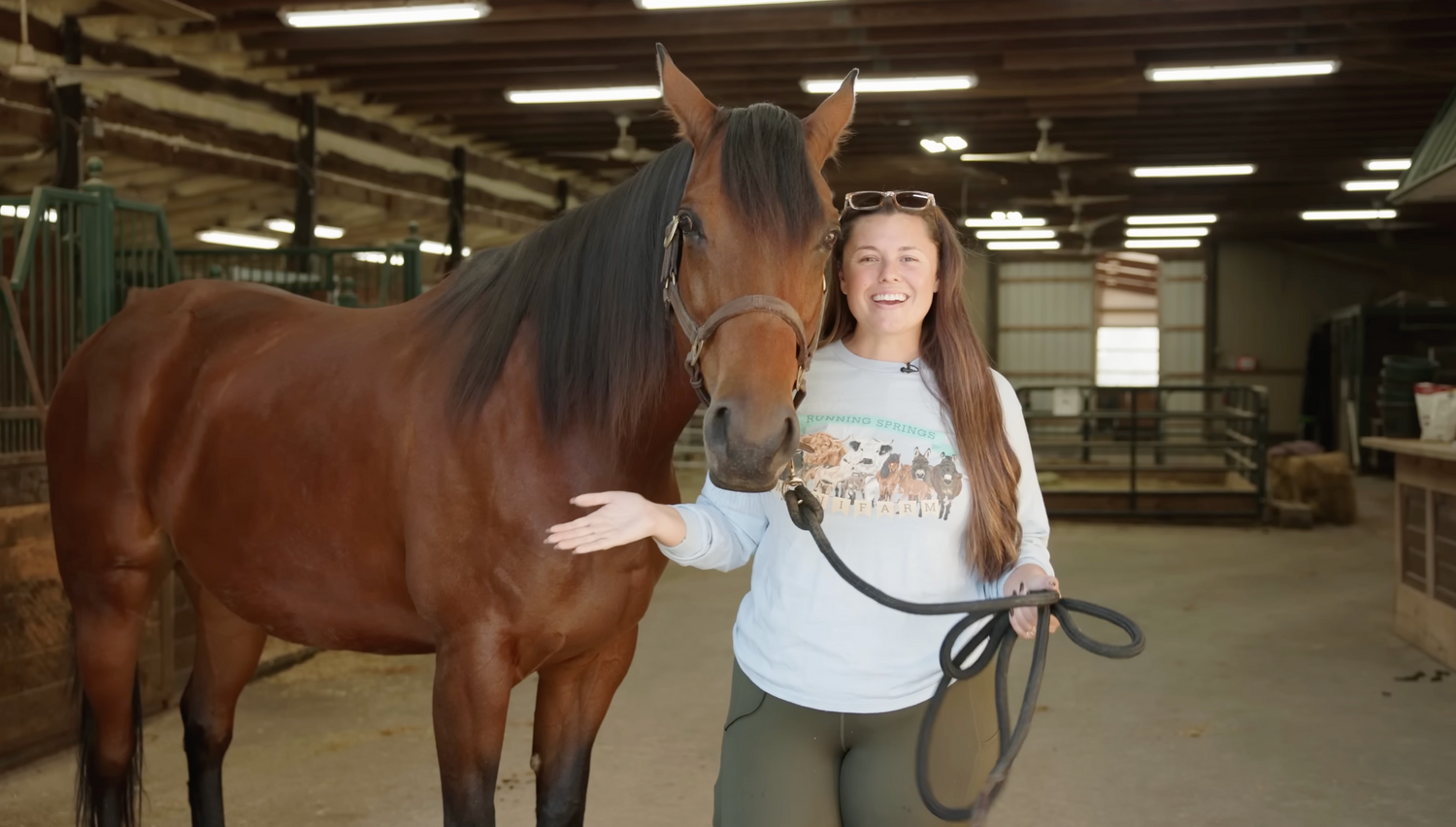
Working with horses is one of the most rewarding parts of life on a farm, whether you are involved in horse breeding, training young prospects, or simply improving your skills as an equestrian.
Today, I am using Trudy, also known as Big Booty Trudy, to walk you through two foundational skills every horse owner should know.
The first is how to measure a horse correctly. The second is how to identify which lead a horse is on when it moves at the canter.
These two concepts come up constantly in farming and horse management, so understanding them will make you more confident and accurate when working with your animals.
- Quick answer: what is a canter lead?
- How to measure a horse correctly
- Walk, trot, and canter explained
- The biomechanics of a horse cantering with a rider
- How to identify the correct canter lead
- How the canter lead feels from the saddle
- How to cue your horse for the correct lead
- What to do if you are on the wrong lead
- Simple and flying lead changes explained
- What is crossfiring?
- Common canter lead mistakes
- Inside the canter at Running Springs
- Frequently asked questions
A canter lead is the front leg that reaches farthest forward during the three-beat canter gait. The horse should be on the inside lead matching the direction of travel — left lead when circling left, right lead when circling right.
The correct lead keeps the horse balanced through turns, protects soundness, and is required for almost every western and english show class that involves the canter or lope.
How to Measure a Horse Correctly

In the United States we measure horses using hands rather than inches. One hand equals four inches. This measurement system began long ago when people did not have easy access to tools, so a hand provided a natural guide.
Today we still use hands because it keeps communication consistent within the equestrian community.
To measure a horse, you measure to the wither. The wither is the raised point at the base of the neck and is the universal location for height measurement.
You can use a soft tape if needed, but a measuring stick with a built-in level ensures accuracy. A soft tape can angle inward toward the horse which gives an incorrect reading. A measuring stick sits a couple of inches away from the body and stays straight.
While adult horses are measured at the wither, younger horses may also be measured at the hip. This helps predict future height during growth stages. Horses often grow butt first which means the hip can be taller than the wither in early development.
Breeders use both measurements when tracking young horses and estimating how tall they may become. This is especially useful in horse breeding programs that focus on height, athleticism, or specific disciplines.
For Trudy, the measuring stick reads between 16.1 and 16.2 hands which translates to just under 168 centimeters. This gives a clear and accurate understanding of her size as a mature mare.
Walk, Trot, and Canter Explained
After measuring, we moved to the round pen to analyze Trudy's gaits. Before understanding leads, you need to understand how each gait works.
The walk is a four beat gait. Each foot hits the ground independently. One, two, three, four. The trot is a two beat gait where diagonal pairs of legs move together.
When Trudy trots, her front left and back right make contact at the same time and then her front right and back left move together. This diagonal motion is what classifies the trot as a two beat gait.
The canter is a three beat gait. Each stride has three distinct impacts before the moment of suspension. Watching in slow motion helps make this much easier to recognize.
The Biomechanics of a Horse Cantering with a Rider
To understand canter leads, you need to understand how the canter gait is built. A horse cantering with a rider goes through this exact sequence:
- Beat one: the outside hind leg strikes the ground first. This is the launching leg for the entire stride.
- Beat two: the inside hind and outside front land together as a diagonal pair.
- Beat three: the inside front (the leading leg) reaches forward and lands last.
- Suspension: all four feet are briefly off the ground before the cycle repeats.
The "lead" gets its name from that third beat. Whichever front leg lands last and reaches farthest forward is the leading leg. On a right lead, it is the right front. On a left lead, it is the left front.
This sequence is why the rider's outside leg is the one that cues the canter — it tells the outside hind leg to strike off and begin the whole stride.
How to Identify the Correct Canter Lead
Now for the part many riders struggle with. The canter lead. When a horse travels to the right, it usually picks up the right lead. When traveling left, the horse normally picks up the left lead.
The lead is determined by which front leg extends the farthest. If the right front is reaching out more than the left, the horse is on the right lead. If the left front reaches farther, the horse is on the left lead.
In the right lead, feet number one and four land together, while the right front has its own distinct beat. In the left lead, feet number two and three land together with the left front extending the most.
This is essential knowledge for any equestrian. Lead choice affects balance, comfort, and control. Riders who work on patterns, transitions, or discipline specific maneuvers rely heavily on the correct lead.
How the Canter Lead Feels from the Saddle
From the ground, you watch the legs. From the saddle, you feel the hips. A horse cantering with a rider creates a distinct rocking motion, and the side that rises and rolls forward tells you the lead.
Here is what to feel for:
- Your inside hip rises and rolls slightly forward with each stride. On a right lead, your right hip leads. On a left lead, your left hip leads.
- Your inside seat bone feels lighter for a split second at the peak of the stride.
- The horse's inside shoulder lifts toward your inside knee as it reaches forward.
The fastest way to learn the feel is to deliberately ride both leads, name each one out loud as you pick it up, and have a ground person confirm. After a few rides, your seat will know before your eyes do.
How to Cue Your Horse for the Correct Canter Lead

Picking up the right lead is not luck. It comes from setting your horse up so the correct lead is the easy answer. Every discipline tweaks the aids slightly, but the four fundamentals are universal:
1. The bend
Flex the horse slightly to the inside before you ask. You should just be able to see the inside eyelash. This positions the horse's body to canter into the turn, not against it.
2. Inside leg at the girth
Your inside leg sits at the girth to create impulsion and to keep the horse from "falling in" through the turn. The inside leg is the engine.
3. Outside leg behind the girth
Slide your outside leg about two to three inches behind the girth. This is the cue that tells the outside hind leg to strike off first — which sets up the entire canter sequence on the correct lead.
4. Balanced seat
Keep your weight squarely and lightly over the saddle. Riders who lean to the inside actually unbalance the horse and often get the wrong lead. Sit tall, soft, and centered.
If you want the broader vocabulary that makes lessons like this easier to absorb, our piece on horse breeding terms every new breeder should know covers the basics every horse owner should have on hand.
What to Do If You Are on the Wrong Lead
It happens to everyone. The transition felt fine, the horse felt forward, and a glance down shows the wrong front leg leading. Here is how to handle it without making a bigger problem:
- Do not panic and yank. Bring the horse calmly back to a trot or walk. A clean downward transition resets the canter cue.
- Re-set the bend. Ask for a few strides of trot with the correct inside bend, then ask for canter again.
- Use a corner to your advantage. Ask for the canter going into a corner. The corner naturally bends the horse and makes the correct lead the easier choice.
- Check your seat. If you keep getting the wrong lead, you may be leaning the wrong way. Have someone watch you canter and call out which lead you are picking up.
Wrong leads are not a moral failing. They are information. A horse that consistently picks up the wrong lead in one direction is telling you something about its body, its training stage, or your position.
Simple and Flying Lead Changes Explained
Once you and your horse are solid on picking up both leads, the next step is changing leads mid-canter. There are two ways to do it:
Simple lead changes
A simple lead change drops the horse from canter to trot (or walk) for a few strides, then asks for canter on the new lead. It is the building block. Every horse learns simple changes before flying changes. Many western show classes test simple lead changes as their own skill.
Flying lead changes
A flying change is what it sounds like — the horse changes leads in the air during the suspension phase of the canter, with no break in gait.
It is what you see in reining, western riding, dressage, and the higher-level hunter classes. It looks easy when a trained horse and rider do it. It takes years to teach a horse to do it cleanly on cue.
If you watch our stallions and show horses on social, you will see flying changes in clinics, lessons, and the show pen — see more of VS Code Red and the rest of our show string in the breeding pages.
What is Crossfiring?
Crossfiring happens when the front end is on one lead and the hind end is on the opposite lead. Horses sometimes do this when they are playing or showing off, and some naturally athletic horses can make it look smoother than others.
Still, crossfiring is usually incorrect and uncomfortable for extended movement. Recognizing it takes practice and a trained eye. Watching slowed down video is one of the best tools for learning to identify it. Over time you will be able to pick out crossfiring instantly.
Common Canter Lead Mistakes Riders Make
A few patterns show up over and over with riders working on canter leads. Watch yourself or a video and see if any of these sound familiar:
- Leaning to the inside. Riders who tip their shoulders to the inside actually unbalance the horse and often get the wrong lead or a crooked canter. Sit tall.
- Asking too late. The cue is most effective when the horse is balanced and slightly bent before you ask. Rushing the canter transition rarely gives you a clean lead.
- Gripping with the legs. A clamped leg makes the horse tense. Soft, clear cues work better than hard ones.
- Forgetting to look up. Looking down at the horse's neck weights the shoulders and shifts your seat forward. Look where you are going.
- Not checking the lead. Riders often stay on the wrong lead for half a lap because they never check. Glance at the inside front shoulder right after the canter departure.
- Punishing the horse for the wrong lead. The horse is responding to the cue you gave. Fix the cue, not the horse.
Inside the Canter at Running Springs

At Running Springs, canter mechanics are not abstract theory. Every horse in our program — from the broodmare band to the show string — needs to canter well.
I show on the AQHA circuit as a non-pro rider, and the all-around classes I compete in (Western Pleasure, Hunter Under Saddle, Western Riding, Horsemanship, Equitation on the Flat) all hinge on correct leads, smooth transitions, and the kind of saddle-feel that only comes from real saddle hours.
Trudy, the mare in this article, is one of our broodmares now, but she came up through the program with the same canter education every show horse here gets.
Her son, Hank (RS Hankwhydoyadrank), went on to be a three-time 2023 Quarter Horse Congress Champion in Hunter Under Saddle. That kind of result is built on canter literacy at every level — knowing the leads, feeling them from the saddle, and producing them on cue.
Even the foals start learning the basics of balance and movement during halter work, long before anyone climbs on board.
The full Running Springs roster, broodmares and show stock together, lives in our meet the herd post.
Cantering, Leads, and the Foundation of Horsemanship
Horses teach us something new every day. Whether you are involved in daily farming routines, managing a horse breeding program, or fine tuning your skills as an equestrian, understanding how to measure horses and recognize leads gives you a deeper connection with your animals.
These are simple but foundational skills that help you communicate clearly with other horse owners and make better decisions in training.
If there are other topics you want explained with visuals, slow motion, or detailed breakdowns, let me know.
I love creating educational content that makes horsemanship easier to understand for everyone. If you want to watch the video version of this blog, click here!
Frequently Asked Questions About Horse Cantering
What does it mean when a horse is on the correct canter lead?
The correct lead is the inside lead matching the direction of travel — left lead when going left, right lead when going right.
The leading leg is the front leg that reaches farthest forward in the third beat of the canter stride. Riding on the correct lead keeps the horse balanced through turns and is required for almost every show class.
How can I tell which lead my horse is on from the saddle?
Feel your hips. Your inside hip rises and rolls slightly forward with each stride on the correct lead.
You can also glance down at the horse's inside front shoulder — it should be reaching farthest forward during the third beat. With practice, you will feel the lead before you ever look.
How do you cue a horse to pick up the correct lead?
Bend the horse slightly to the inside, put your inside leg at the girth for impulsion, slide your outside leg two to three inches behind the girth to cue the outside hind to strike off first, and keep your seat balanced and tall. Asking into a corner makes the correct lead even easier for the horse.
Why does my horse keep picking up the wrong lead?
The most common causes are an unbalanced rider seat, asking on a straightaway instead of into a corner, missing the inside bend, or the horse having a stronger or weaker side.
A horse that always picks up the wrong lead in one direction may need bodywork or targeted training on the weaker side.
What is the difference between a simple and a flying lead change?
A simple lead change drops the horse from canter to trot (or walk) for a few strides, then re-asks for canter on the new lead. A flying lead change asks the horse to change leads in mid-air during the suspension phase of the canter, with no break in gait.
Flying changes are seen in reining, western riding, dressage, and upper-level hunters.
How long does it take to learn canter leads as a rider?
Most riders can identify both leads visually within a few lessons and can feel both from the saddle within a few months of consistent canter work.
Reliably cueing for the correct lead on a green horse — or producing flying changes — takes years of practice for both horse and rider.
Keep Reading
If horsemanship and life inside the barn is on your mind, these next reads from Running Springs are a natural place to head.
- Horse breeding terms every new breeder should know — the vocabulary that makes everything else easier.
- Heartbeat checks: a crucial step in horse breeding — how we monitor every pregnancy from day one.
- A look inside foaling season at Running Springs — the highs, the long nights, and what makes it all worth it.
- Breeding season insights from our barn — how decisions made months ago shape the foaling you get.
- How many animals does Katie Van Slyke have? — the full Running Springs animal count.
Sources
The canter biomechanics, rider aids, and lead change progressions in this article are drawn from published equestrian and veterinary resources. They are educational only and do not replace working with a qualified instructor or trainer.
About the Author

Hi, I am Katie Van Slyke!
I breed AQHA Quarter Horses at my family farm in Tennessee, stand two stallions, and document foaling season every year from the barn floor while sharing the daily realities of farm life.
I am incredibly lucky to share this journey with millions of friends across YouTube, TikTok, Facebook, and Instagram. You can read the full story of how it all started on my about page.













1 comment
Katie – you and your team take such good care of all your animals – and track them (weight, height, etc.) How do you keep track the medical, treatment, measurement, etc data for each of your animals, especially now that your herds have expanded! Are their specialized software tools? is there a massive room of binders? or? Thanks!