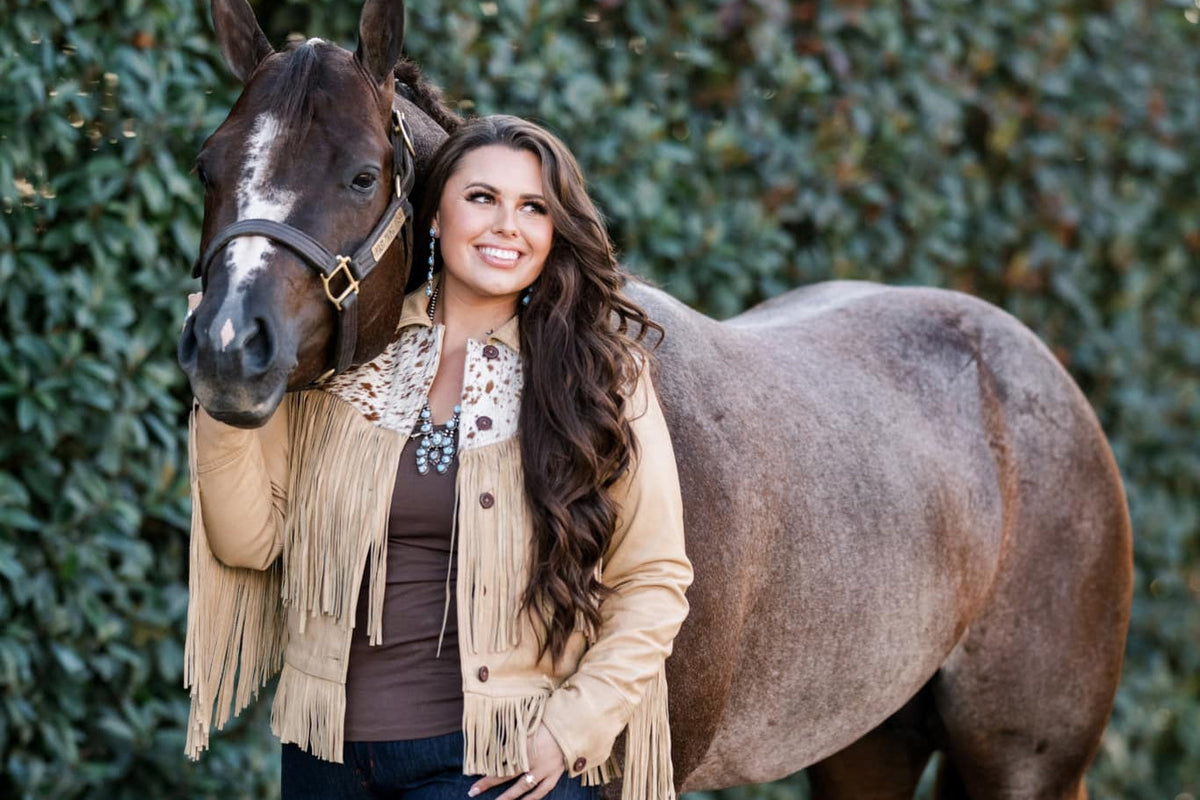
Hi y'all, Katie Van Slyke here! If you have ever stood at a barn and felt completely lost while everyone else fired off horse terms you had never heard before, you are not alone.
Equestrian vocabulary runs deep — anatomy, gaits, tack, colors, riding cues, health terminology, breeding language, and a whole pile of barn slang that nobody explains until you are already supposed to know it.
Today, I'll walk you through the complete horse vocabulary every beginner should learn — from horse types and gaits to tack, colors, breeding methods, and the slang you'll actually hear in the barn. Stick with me.
- Why Learning Horse Terms Matters
- Horse Types and Genders
- Horse Anatomy and Body Parts
- Horse Gaits
- Tack and Equipment Terms
- Riding and Horsemanship Terms
- Horse Colors and Markings
- Horse Health and Behavior Terms
- Horse Slang and Barn Talk
- Horse Breeding Terms
- What Else Do You Want to Learn?
- Frequently Asked Questions
Why Learning Horse Terms Matters
Whether you are a beginner walking into your first riding lesson, a parent helping a horse-crazy kid, or someone who has been following along with our breeding season at Running Springs, knowing the lingo makes everything easier.
Equestrian terms are not just barn snobbery — they are the shortcut that lets riders, trainers, vets, and breeders all communicate clearly.
A trainer who says "circle right at the lope" needs you to know what a lope is. A vet who says "she has a clean six panel" expects you to know what that means.
This glossary covers the most essential horse vocabulary across nine categories, plus the breeding terms we hear constantly at Running Springs.
By the end of it, you will recognize almost everything you hear at a barn, in a lesson, or in one of our breeding-season videos.
Horse Types and Genders
These are the first horse terms most beginners learn — and the ones you will hear constantly at any barn.
| Term | What it means |
|---|---|
| Equine | The general family that includes horses, donkeys, mules, and zebras. |
| Equestrian | A person who rides or handles horses, or anything related to horseback riding. |
| Horse | Any equine over 14.2 hands at the withers (taller than 58 inches). |
| Pony | An equine 14.2 hands or shorter, regardless of build. |
| Mare | A female horse four years old or older. |
| Stallion | An intact male horse four years old or older. |
| Gelding | A castrated male horse. |
| Foal | A baby horse of either gender, under one year old. |
| Colt | A male foal or young male horse under four years old. |
| Filly | A female foal or young female horse under four years old. |
| Yearling | A horse between one and two years old. |
| Weanling | A foal that has been weaned from its mother, usually around four to six months. |
| Suckling | A foal still nursing from its mother. |
| Broodmare | A mare used for breeding and producing foals. |
| Sire | The father of a foal. |
| Dam | The mother of a foal. |
| Recipient mare (recip) | A surrogate mare who carries another mare's embryo to term. |
| Maiden mare | A mare who has never been bred or has never carried a foal. |
| Green | An inexperienced horse, or one that is just starting its training. |
| Hot-blooded | A breed type known for energy, sensitivity, and speed (e.g., Thoroughbreds, Arabians). |
| Cold-blooded | A breed type known for calm temperament and heavy build (e.g., draft horses). |
| Warmblood | A breed type that crosses hot and cold blood for sport horse uses. |
| Hand | A unit of measurement for horse height. One hand equals four inches. |
For more on the stallions and broodmares that fuel our breeding program, check out our stallion VS Code Red.
Horse Anatomy and Body Parts
Knowing the parts of the horse is essential for grooming, riding, vet calls, and just describing what you are seeing. These are the anatomy terms every beginner should learn.
| Term | What it means |
|---|---|
| Withers | The ridge between the shoulder blades. Horse height is measured here. |
| Poll | The highest point of the skull, directly between the ears. |
| Muzzle | The soft area at the front of the face, including the nose and lips. |
| Forelock | The section of mane that falls forward onto the horse's forehead. |
| Mane | The long hair that grows along the top of the neck. |
| Crest | The top of the neck where the mane grows. |
| Throatlatch | The area where the head meets the neck, under the jaw. |
| Shoulder | The large muscle group between the neck and front legs. |
| Forearm | The upper part of the front leg above the knee. |
| Knee | The joint in the middle of the front leg. |
| Cannon bone | The long bone between the knee and fetlock on the front leg (or hock and fetlock on the back). |
| Fetlock | The joint just above the hoof on every leg. |
| Pastern | The short section between the fetlock and the hoof. |
| Coronet (coronary band) | The ring at the top of the hoof where new hoof tissue grows. |
| Hoof | The hard outer foot. |
| Frog | The triangular soft tissue on the underside of the hoof. |
| Sole | The bottom surface of the hoof. |
| Heel | The back of the hoof. |
| Chestnut | The horny growth on the inside of each leg. (Also the name of a coat color.) |
| Ergot | The small horny growth on the back of the fetlock. |
| Barrel | The midsection of the horse, where the saddle sits and the ribs are. |
| Girth area | The narrow area behind the front legs where the girth or cinch sits. |
| Flank | The area between the ribs and the hip. |
| Loin | The lower back, just behind the saddle area. |
| Croup | The top of the hindquarters from the loin to the tail. |
| Dock | The base of the tail. |
| Hip | The point of the hindquarters. |
| Stifle | The large joint in the hind leg, equivalent to the human knee. |
| Gaskin | The muscular area of the hind leg above the hock. |
| Hock | The large joint in the hind leg between the gaskin and the cannon bone. |
Daily horse life shows up across our Classic Apparel collection — for the folks who measure their days in feed scoops and tack rooms.
Horse Gaits
A gait is simply how a horse moves. Each gait has a different rhythm, speed, and number of beats. Learning the gaits is one of the first things a new rider should know.
| Term | What it means |
|---|---|
| Walk | The slowest, four-beat gait. Each hoof hits the ground separately. |
| Trot | A two-beat diagonal gait. In Western riding, this is called the jog. |
| Jog | The Western term for a slow, smooth trot. |
| Canter | A three-beat gait faster than a trot. In Western riding, this is called the lope. |
| Lope | The Western term for a slow, relaxed canter. |
| Gallop | The fastest, four-beat gait. The all-out run. |
| Hand gallop | A controlled gallop, faster than canter but not full speed. |
| Pace | A two-beat gait where the legs on the same side move together. Common in Standardbreds. |
| Collected gait | Any gait where the horse engages from behind and shortens stride while staying balanced. |
| Extended gait | Any gait where the horse covers maximum ground per stride. |
| Lead | Which front leg leads at the canter or lope. Horses can be on the left lead or right lead. |
| Lead change | Switching from one lead to the other. Can be a simple change (through trot/walk) or flying change (mid-canter). |
If gaits feel confusing, our piece on canter vs gallop breaks the two fastest gaits apart in detail, and our canter and leads guide goes deep on lead recognition.
Tack and Equipment Terms
"Tack" is the umbrella term for all the equipment that goes on a horse for riding or handling. These are the pieces every rider should be able to name.
| Term | What it means |
|---|---|
| Tack | All the equipment used on a horse — saddle, bridle, bit, halter, and accessories. |
| Tack up | To put the tack on a horse before riding. |
| Untack | To remove the tack after riding. |
| Saddle | The seat that goes on the horse's back for riding. Comes in English and Western styles. |
| Saddle pad / blanket | The cushioned layer between the horse's back and the saddle. |
| Pommel | The front raised part of an English saddle. |
| Cantle | The back raised part of a saddle. |
| Horn | The knob on the front of a Western saddle (used for roping). |
| Stirrup | The loop where the rider's foot sits. |
| Stirrup leather | The strap that holds the stirrup to the saddle. |
| Bridle | The headgear that holds the bit and reins. |
| Bit | The mouthpiece in the bridle used to communicate with the horse through the reins. |
| Snaffle bit | A direct-pressure bit with a jointed mouthpiece, commonly used for training. |
| Curb bit | A leverage bit used in Western and finished English riding. |
| Reins | The straps the rider holds to communicate with the bit. |
| Girth (English) / Cinch (Western) | The strap that holds the saddle on the horse's back. |
| Halter | The headgear used for leading, tying, and handling. Has no bit. |
| Lead rope | The rope clipped to the halter for leading the horse. |
| Martingale | A strap that helps control head carriage during riding. |
| Breastplate | A strap across the chest that keeps the saddle from sliding back. |
| Bell boots | Rubber boots that protect the front hooves from being struck by the back hooves. |
| Polo wraps | Long fabric wraps that protect a horse's legs during training. |
| Crop / whip | A short stick used to reinforce leg aids. |
| Spurs | Small metal pieces worn on the rider's boots to reinforce leg aids. |
For more on the specific tack we use, our essential guide to bell boots covers protective gear for the front legs.
Riding and Horsemanship Terms
These are the terms you will hear in lessons, at shows, and any time someone is in the saddle. Knowing them changes how fast you progress as a rider.
| Term | What it means |
|---|---|
| Mount | To get on the horse. |
| Dismount | To get off the horse. |
| Near side | The left side of the horse. The standard side for mounting and leading. |
| Off side | The right side of the horse. |
| Posting trot | The rider rises and sits in rhythm with the horse's trot. |
| Sitting trot | The rider stays seated through the trot without rising. |
| Two-point | The rider lifts out of the saddle into a forward, half-standing position over jumps or gallops. |
| Half-seat | A balanced position partway between sitting and two-point. |
| Aids | The signals the rider uses to communicate. Natural aids (legs, hands, seat, voice) and artificial aids (crop, spurs). |
| Half-halt | A brief rebalancing aid that asks the horse to come back to the rider. |
| On the bit | The horse is engaged, accepting the bit, and moving forward into contact. |
| Behind the bit | The horse drops contact and avoids the bit by tucking the head behind the vertical. |
| Behind the leg | The horse is sluggish and not responding promptly to leg aids. |
| Forward | The horse moves with energy and willingness from the rider's leg. |
| Schooling | Training a horse — repetition of exercises to improve skills. |
| Hack | A casual ride, often outside the arena, for fun or exercise. |
| Trail ride | Riding outside the arena on a designated trail. |
| Warm up / cool down | The opening and closing parts of a ride to prepare the horse physically and mentally. |
| Whoa | The verbal cue to stop. |
| Cluck | The "tongue cluck" sound used to encourage forward movement. |
| Round pen | A small enclosed circular pen used for ground work and early riding. |
| Lunge / longe | To exercise a horse on a long line in a circle. |
For new riders just stepping into a barn for the first time, our beginner horse riding lessons guide walks through what to expect.
Horse Colors and Markings
Horses come in dozens of coat colors and combinations. Here are the most common ones you will hear named at any barn or show.
| Term | What it means |
|---|---|
| Bay | Reddish-brown body with black mane, tail, and lower legs. |
| Chestnut | Solid reddish-brown body, with mane and tail the same color or lighter. |
| Sorrel | A lighter reddish chestnut. Common in Quarter Horses. |
| Black | Truly black coat, with no brown showing. |
| Gray | A coat that lightens with age. Born any color, fades to white over time. |
| Roan | White hairs mixed evenly through a base color (red roan, blue roan, bay roan). |
| Palomino | Golden body with a white mane and tail. |
| Buckskin | Tan or yellow body with black mane, tail, and legs. |
| Dun | Tan body with a darker dorsal stripe down the back. |
| Grullo | A smoky gray dun with primitive markings. |
| Pinto / Paint | A horse with large patches of white and another color. |
| Tobiano | A specific pinto pattern with white crossing the back between the withers and tail. |
| Overo | A specific pinto pattern with white that typically does not cross the back. |
| Appaloosa | A spotted breed and pattern. Often features a blanket of spots over the hindquarters. |
| Star | A white marking on the forehead. |
| Stripe | A narrow white marking running down the face. |
| Snip | A small white marking on the muzzle. |
| Blaze | A wide white marking running down the face. |
| Bald face | A very wide white face marking, often extending past the eyes. |
| Sock | White on the leg up to the fetlock or partway up the cannon. |
| Stocking | White on the leg extending up to the knee or hock. |
Horse Health and Behavior Terms
These are the terms you will hear during vet calls, pre-purchase exams, and any conversation about how a horse is doing physically.
| Term | What it means |
|---|---|
| Sound | The horse is moving comfortably with no signs of lameness or pain. |
| Lame | The horse is favoring a limb or moving with pain. |
| Colic | Abdominal pain in horses. One of the most common and serious equine emergencies. |
| Founder / Laminitis | Inflammation of the sensitive tissues inside the hoof. A serious condition. |
| Heaves (COPD) | A chronic respiratory condition similar to asthma. |
| Choke | An esophageal blockage, often from food. Requires immediate vet attention. |
| Strangles | A highly contagious bacterial respiratory infection. |
| Thrush | A bacterial infection of the frog area of the hoof. |
| EPM | Equine Protozoal Myeloencephalitis. A neurological disease caused by protozoa. |
| Placentitis | Infection of the placenta during pregnancy. Can cause premature foaling. |
| Cribbing | A stable vice where the horse grabs onto wood and sucks in air. |
| Weaving | A stable vice where the horse rocks back and forth. |
| Spook | A sudden startled reaction to something the horse sees or hears. |
| Buck | Kicking out the back legs while raising the hindquarters. |
| Rear | Standing up on the back legs. |
| Bolt | To suddenly take off at speed. |
| Withers up | A horse moving with proper engagement and lifted withers. |
| Six panel negative | Genetic testing showing the horse is clear of six major hereditary diseases (GBED, HERDA, HYPP, MH, PSSM1, IMM). |
For more on pregnancy-related terminology, our pregnancy in mares pillar goes deep on every stage.
Horse Slang and Barn Talk
These are the casual terms you will hear thrown around at any barn — and the slang nobody ever formally teaches you.
| Term | What it means |
|---|---|
| Hot | A high-strung, energetic horse who can be difficult to ride. ("She's a hot ride.") |
| Quiet | A calm, easygoing horse. ("He's so quiet, you can throw a beginner on him.") |
| Made | A well-trained, finished horse with all the buttons installed. ("She's a made show horse.") |
| Bombproof | A horse that doesn't spook at much. Ideal for beginners. |
| Push button | A made horse who responds immediately to subtle cues. Often expensive. |
| Babied | A horse that has been spoiled or coddled, often resulting in disrespectful behavior. |
| Mouthy | A horse who nibbles or chews on things, including people. |
| Light in the mouth | A horse with a sensitive, responsive mouth that doesn't need heavy rein contact. |
| Hard mouth | A horse that has learned to ignore bit pressure. Usually from rough handling. |
| Couchy | A horse with a super smooth, comfortable ride. "Couch" of a horse. |
| Schoolmaster | An experienced older horse who teaches riders proper technique. |
| Project | An untrained or partially-trained horse that needs work to develop. |
| Yard horse / pasture pet | A horse that is retired from riding but still cared for. |
| Off the track (OTTB) | Off the Track Thoroughbred. A racehorse retrained for another discipline. |
| Trail-broke | Comfortable being ridden out on trails. |
| Started | A horse in the early stages of training under saddle. |
| Finished | A fully trained horse, ready for show or work. |
Every "RS" foal born at Running Springs becomes part of our family lineup. Browse our foals collection for designs that celebrate the next generation.
Horse Breeding Terms
Breeding season is right around the corner, which means you'll soon be hearing a lot of specific horse breeding terms around here.
Whether you're new to horse farming, considering breeding a mare someday, or you just want to better understand what happens behind the scenes, this guide will walk you through a few essential concepts.
We're only scratching the surface, but these five terms will give you a solid foundation to follow along this season.
1. What Is Animal Husbandry?
Before getting into the technical parts of horse breeding, it helps to understand animal husbandry. This is the branch of agriculture focused on the care, breeding, and management of livestock.
Sheep may be raised for wool, cattle for dairy or beef, and horses for performance, sport, or ranch work.
Here on our farm, horse husbandry is a core part of what we do, caring for and managing horses in a way that supports their health, performance, and future generations.
Animal husbandry is the umbrella term that every other breeding concept falls under.
2. What Is Live Cover?
The first hands-on breeding method is called live cover. This is the traditional and most natural breeding process, the stallion and mare are physically present together, and breeding happens naturally without technological intervention.
Live cover is used widely around the world and is Mandated in some breeds like the Thoroughbred industry. However, it's not a method we typically use.
Our farm focuses on safer and more controlled practices that reduce stress and injury risks for both mare and stallion.
3. What Is Artificial Insemination?
The most common method you'll see on this channel is artificial insemination. It offers several benefits to horse breeders:
- The stallion does not have to be present
- Semen can be shipped from anywhere in the country
- A single collection can breed multiple mares
- Lower risk of injury compared to live cover
The breeder closely monitors the mare's ovulation, often by ultrasound, then semen is inserted into the mare's reproductive tract at the perfect moment to increase the chance of pregnancy.
Artificial insemination has become one of the most important advancements in modern horse breeding and horse farming because it opens up access to top stallion genetics worldwide.
4. What Is Embryo Transfer?
Next up is embryo transfer, a method that allows you to get foals from valuable mares without requiring them to carry the pregnancy. Instead, a surrogate mare called a "recipient mare" carries and foals the baby.
Here's how it works:
- The donor mare is bred and ovulates normally
- About 7 days later, the embryo is flushed out
- The embryo is placed into a synchronized recipient mare
- If all goes well, she becomes pregnant and raises the foal
This is helpful for mares still in competition or ones who should not carry due to health or performance goals. It's a great option to preserve genetics while keeping the donor mare actively working.
5. What Is ICSI (Intracytoplasmic Sperm Injection)?
ICSI — pronounced "ick-see", is a more advanced form of assisted reproduction. It's similar to techniques used in human fertility medicine.
Steps in the ICSI process:
- Eggs are collected (via follicle aspiration) from the donor mare
- Each egg is matured in a lab
- One single sperm is injected directly into the egg
- The fertilized embryos continue developing in the lab
- They are frozen or transferred into a recipient mare later
One mare can produce many eggs in one session, which means multiple chances at embryos and future foals. We often freeze embryos and use them when breeding season officially arrives.
ICSI adds flexibility and increases breeding opportunities when timing, travel, or cycles don't line up naturally.
What Does "Six Panel Negative" Mean?
You'll often hear the term six panel negative when discussing stallions and mares approved for breeding. This refers to the horse being clear of six major genetic diseases commonly tested in Quarter Horses and Paints. Some are recessive and some are dominant, and carriers can pass them to foals.
Testing genetics ensures breeders choose sires and dams that give foals the best chance of a healthy life. In responsible horse breeding programs, knowing a horse's genetic status is non-negotiable.
What Else Do You Want to Learn?
These horse farming and breeding terms are just the beginning. There are so many more details, ultrasounds, ovulation timing, semen quality, foal development, and more.
If there are phrases you've heard me say that you want explained, let me know! We'll continue breaking these down in future posts so you can follow along confidently as breeding season kicks off soon.
Stay tuned, and thanks for learning with us!
Frequently Asked Questions About Horse Terms
What are the basic horse terms every beginner should know?
The most important basic horse terms cover horse types and genders (mare, stallion, gelding, foal), anatomy (withers, poll, hoof), gaits (walk, trot, canter, gallop), tack (saddle, bridle, bit), and the basics of riding (near side, off side, mounting, posting). Knowing these makes it much easier to follow along at a barn or in a lesson.
What is a green horse?
A "green" horse is an inexperienced horse or one that is just starting its training.
Green horses can be any age — a 3-year-old being started under saddle is green, and so is an older horse that was never properly broke to ride. Green horses generally need a confident, experienced rider.
What is the difference between a mare, stallion, and gelding?
A mare is a female horse four years or older. A stallion is an intact male horse four years or older.
A gelding is a castrated male horse. Younger horses are called foals (under one year), then yearlings, with colts (males) and fillies (females) used until they reach mare or stallion age.
What does "tack" mean?
Tack is the general term for all the equipment used on a horse for riding and handling — saddle, bridle, bit, reins, halter, lead rope, saddle pad, girth or cinch, and stirrups. "Tack up" means to put the tack on, and "untack" means to take it off.
How tall is a hand on a horse?
One "hand" equals four inches. Horse height is measured from the ground to the top of the withers (the ridge between the shoulder blades).
15-hand horse is 60 inches tall at the withers. Ponies are typically 14.2 hands and under; horses are above 14.2 hands.
What does "near side" and "off side" mean?
The "near side" is the left side of the horse — the standard side for mounting, leading, and most handling.
The "off side" is the right side. This terminology comes from centuries of cavalry tradition and is still used universally in modern equestrian disciplines.
What does "six panel negative" mean?
Six panel negative means a horse has been genetically tested and is clear of six major genetic diseases commonly found in Quarter Horses and Paints (GBED, HERDA, HYPP, MH, PSSM1, and IMM).Six panel negative status is non-negotiable in responsible breeding programs because carriers can pass these conditions to foals.
Keep Reading
Want to keep building your horse vocabulary? These next reads from Running Springs are a natural place to head.
- Canter vs gallop: speed, rhythm and what sets the two gaits apart
- Horse cantering with a rider: leads, cues, and lead changes
- Pregnancy in mares: a complete guide from Running Springs
- The essential guide to bell boots for horses
- How to groom a horse: a beginner's step-by-step guide
- Beginner horse riding lessons: what to expect in the barn
About the Author

Hi, I am Katie Van Slyke!
I breed AQHA Quarter Horses at my family farm in Tennessee, stand two stallions, and document foaling season every year from the barn floor while sharing the daily realities of farm life.
I am incredibly lucky to share this journey with millions of friends across YouTube, TikTok, Facebook, and Instagram. You can read the full story of how it all started on my about page.









1 comment
wow katie whats mooses regrstation