
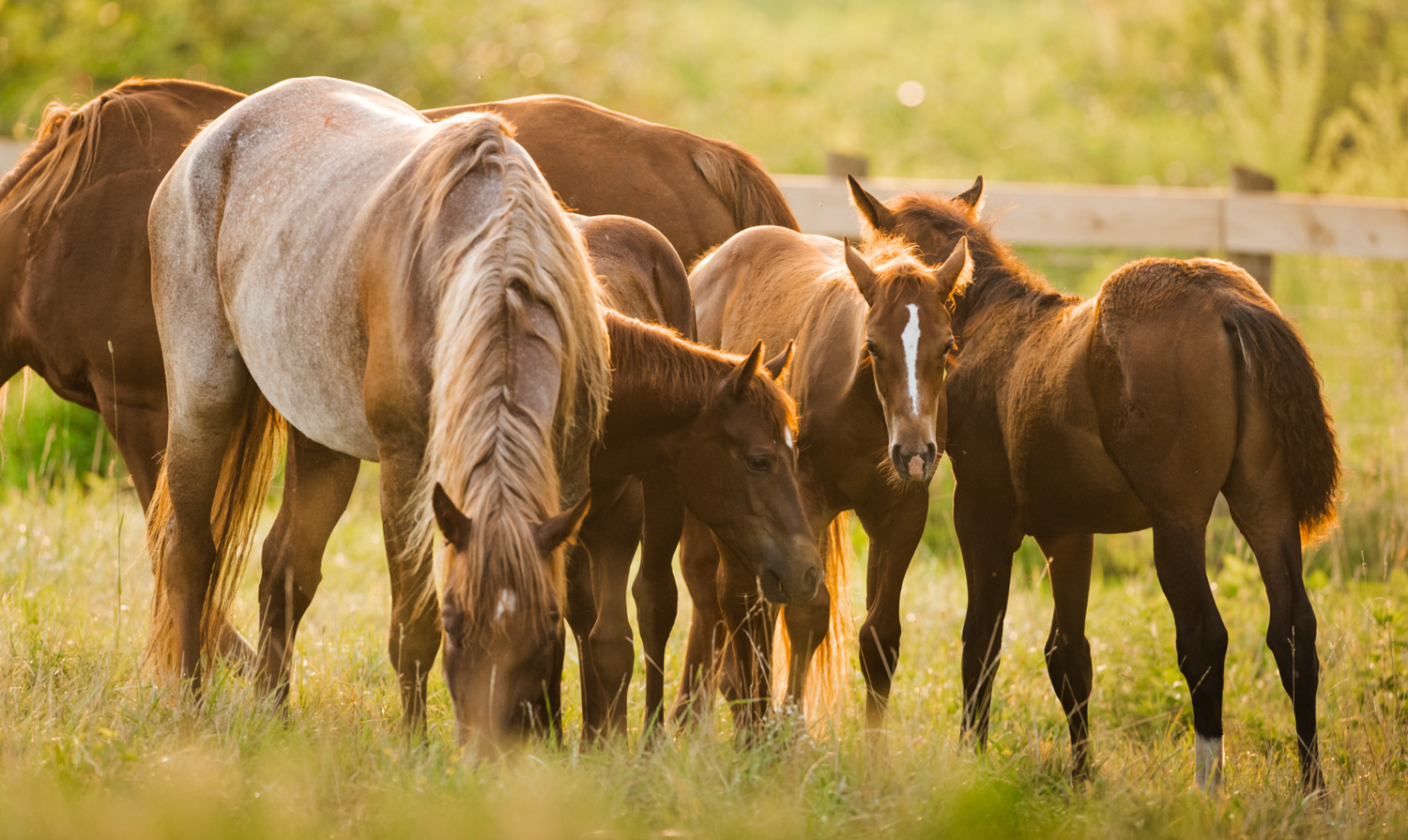
I breed AQHA Quarter Horses at Running Springs and document every foaling season from the barn floor, so these are the terms I actually use around the farm, not textbook definitions.
Breeding season is right around the corner, which means you'll soon be hearing a lot of specific horse breeding terms around here.
Whether you're new to horse farming, considering breeding a mare someday, or you just want to better understand what happens behind the scenes, this guide will walk you through a few essential concepts.
We're only scratching the surface, but these terms will give you a solid foundation to follow along this season.
What Are the Most Common Horse Breeding Terms?

Most horse breeding terms fall into four groups: words for a horse's parents and age (like sire, dam, colt, and filly), pedigree and bloodline words (like damsire, top, and bottom), the breeding methods themselves (live cover, artificial insemination, embryo transfer, and ICSI), and health and foaling words (like six panel negative and waxed up).
Below I break down the ones you'll hear me use most around Running Springs, starting with the hands-on breeding methods and then moving to the family-tree and foaling words that go with them.
If you're brand new around here, my FAQ page is a good place to start too.
What Is Animal Husbandry?

Before getting into the technical parts of horse breeding, it helps to understand animal husbandry. This is the branch of agriculture focused on the care, breeding, and management of livestock.
Sheep may be raised for wool, cattle for dairy or beef, and horses for performance, sport, or ranch work. Here on our farm, horse husbandry is a core part of what we do, caring for and managing horses in a way that supports their health, performance, and future generations.
Animal husbandry is the umbrella term that every other breeding concept falls under.
What Is Live Cover?
The first hands-on breeding method is called live cover. This is the traditional and most natural breeding process, the stallion and mare are physically present together, and breeding happens naturally without technological intervention.
Live cover is used widely around the world and is Mandated in some breeds like the Thoroughbred industry. However, it's not a method we typically use. Our farm focuses on safer and more controlled practices that reduce stress and injury risks for both mare and stallion.
What Is Artificial Insemination?

Image source: vetmedbiosci.colostate.edu/
The most common method you'll see on this channel is artificial insemination. It offers several benefits to horse breeders:
- The stallion does not have to be present
- Semen can be shipped from anywhere in the country
- A single collection can breed multiple mares
- Lower risk of injury compared to live cover
The breeder closely monitors the mare's ovulation, often by ultrasound, then semen is inserted into the mare's reproductive tract at the perfect moment to increase the chance of pregnancy. Artificial insemination has become one of the most important advancements in modern horse breeding and horse farming because it opens up access to top stallion genetics worldwide.
What Is Embryo Transfer?
Next up is embryo transfer, a method that allows you to get foals from valuable mares without requiring them to carry the pregnancy. Instead, a surrogate mare called a "recipient mare" carries and foals the baby.
Here's how it works:
- The donor mare is bred and ovulates normally
- About 7 days later, the embryo is flushed out
- The embryo is placed into a synchronized recipient mare
- If all goes well, she becomes pregnant and raises the foal
This is helpful for mares still in competition or ones who should not carry due to health or performance goals. It's a great option to preserve genetics while keeping the donor mare actively working.
What Is ICSI (Intracytoplasmic Sperm Injection)?

ICSI — pronounced "ick-see", is a more advanced form of assisted reproduction. It's similar to techniques used in human fertility medicine.
Steps in the ICSI process:
- Eggs are collected (via follicle aspiration) from the donor mare
- Each egg is matured in a lab
- One single sperm is injected directly into the egg
- The fertilized embryos continue developing in the lab
- They are frozen or transferred into a recipient mare later
One mare can produce many eggs in one session, which means multiple chances at embryos and future foals. We often freeze embryos and use them when breeding season officially arrives. ICSI adds flexibility and increases breeding opportunities when timing, travel, or cycles don't line up naturally.
What Does "Six Panel Negative" Mean?
You'll often hear the term six panel negative when discussing stallions and mares approved for breeding. This refers to the horse being clear of six major genetic diseases commonly tested in Quarter Horses and Paints. Some are recessive and some are dominant, and carriers can pass them to foals.
Testing genetics ensures breeders choose sires and dams that give foals the best chance of a healthy life. In responsible horse breeding programs, knowing a horse's genetic status is non-negotiable.
Horse Gender and Age Terms: Sire, Dam, Colt, and Filly

Before you can read a pedigree or follow a breeding plan, it helps to know what to call each horse. The male parent of a horse is the sire, and the mother is the dam. From there, what you call a horse changes with its age and sex.
| Term | What it means |
|---|---|
| Sire | The father of a foal. When people ask what the male parent of a horse is called, the sire is the answer. |
| Dam | The mother of a foal. (You'll sometimes see it written "dame," but the correct spelling is dam.) |
| Stallion | An intact adult male horse used for breeding. So if you're wondering what a male horse is called, a grown breeding male is a stallion, while a young one is a colt. |
| Mare | An adult female horse. |
| Colt | A young male horse, usually under four years old. |
| Filly | A young female horse, usually under four years old. |
| Foal | A baby horse of either sex, from birth until it is weaned. |
| Weanling | A foal that has been weaned off its dam, usually around six months old. |
| Yearling | A horse between one and two years old. |
| Gelding | A castrated male horse, not used for breeding. |
| Broodmare | A mare kept specifically for producing foals rather than for showing or riding. |
So the short version of dam vs sire is simple: the sire is the dad, the dam is the mom, and every foal is "by" its sire and "out of" its dam. You'll see me list the boys, like VS Code Red, as the sire on a lot of our foal announcements. Once our babies are old enough, they move on as weanlings and yearlings, and you can meet the whole crew and their registered names in our herd roundup.
Love the boys as much as I do? You can shop The Boys stallion collection and our foals merch any time you want to rep the farm.
Reading an Equine Pedigree: Bloodlines, Lineage, and "Top and Bottom"
A pedigree is simply a horse's family tree, the chart that shows its bloodline and lineage going back several generations. Learning to read one is how breeders make smart matches, and it's where a lot of horse breeding lingo comes from.
- Pedigree: The written record of a horse's ancestors, usually shown as a chart of sires and dams going back four or more generations.
- Bloodline / lineage: The line of ancestors a horse descends from. Strong bloodlines are a big part of why certain foals are so sought after.
- Top and bottom: On a pedigree chart, the "top" is the sire's side (the father's line) and the "bottom" is the dam's side (the mother's line).
- Damsire (broodmare sire): The sire of a horse's dam, in other words the foal's maternal grandfather.
- Half-sibling: In horses, half-siblings share the same dam but have different sires. Horses by the same sire out of different dams usually are not called half-siblings.
- By and out of: A foal is always "by" its sire and "out of" its dam.
- Nick: When two bloodlines cross especially well and keep producing standout foals, breeders call it a good "nick."
If you want to look up any horse's family tree yourself, the free All Breed Pedigree database lets you search pedigrees across breeds. It's a fun rabbit hole once you know what top and bottom mean. You can also see how we name our own foals and cattle in our post on the registered names of my mini horses and cattle.
Foaling and Pregnancy Terms: Gestation, "Waxed Up," and More
Once a mare is pregnant, a whole new set of horse breeding terms kicks in around her due date and delivery.
- Gestation: How long a mare carries her foal, on average about 11 months (roughly 340 days), though a healthy range runs from about 320 to 380 days.
- Due date or safe date: Because that range is so wide, a horse's due date is really just an estimate. The "safe date" is the point in pregnancy when a foal has a good chance of surviving if it arrives.
- Waxed up: In the last day or two before foaling, many mares develop small beads of colostrum on their teats that look like drops of wax. "Waxed up" usually means foaling is about 24 to 48 hours away.
- Yeld mare (sometimes written yield mare): A mare that did not produce or carry a foal during a given breeding season.
Foaling season is my absolute favorite time of year, and I document just about all of it. You can follow along with our foaling season updates, see who's due in our 2026 foaling season preview, and read up on what happens right after a foal arrives in our placenta care guide and our post on foal slippers.
I share farm, breeding, and foaling season updates over on my YouTube channel. Here's one to watch while you're learning the lingo.
I also post quick breeding and foaling clips on TikTok, like this one and this one, if you'd rather watch than read.
What Else Do You Want to Learn?
These horse farming and breeding terms are just the beginning. There are so many more details, ultrasounds, ovulation timing, semen quality, foal development, and more. If there are phrases you've heard me say that you want explained, let me know! We'll continue breaking these down in future posts so you can follow along confidently as breeding season kicks off soon.
Stay tuned, and thanks for learning with us!
New around here? Get to know me on my about page, or browse all the Running Springs merch while you follow along this season.
Frequently Asked Questions About Horse Breeding Terms
What is the male parent of a horse called?
The male parent of a horse is called the sire. If that male horse is a grown, intact male used for breeding, he is also called a stallion, and a young male is a colt. You can see our own sires on our stallions page.
What is the difference between a dam and a sire?
The sire is the father and the dam is the mother. Every foal is "by" its sire and "out of" its dam. People sometimes type "dame vs sire," but the correct spelling is dam.
What does "out of" mean when talking about a horse's pedigree?
"Out of" refers to the dam, the mother. A foal is "by" the stallion (sire) and "out of" the mare (dam). So "a foal by the sire, out of the dam" tells you both parents at a glance.
Where can I look up a horse's pedigree?
You can look up most horses on the free All Breed Pedigree database, which shows sires, dams, and bloodlines across breeds. Breed associations like AQHA also keep official pedigree records for registered horses.
What is a broodmare?
A broodmare is a mare kept specifically for having foals rather than for showing or riding. Ours are a huge part of the program, and I track their pregnancies in posts like our broodmare bump date update.
What is the difference between a colt and a filly?
A colt is a young male horse and a filly is a young female horse, both usually under four years old. After that, males become stallions (or geldings if castrated) and females become mares.
Meet the Herd at Running Springs
If you're just finding the farm, come follow along. I share breeding, foaling, and everyday farm life with millions of friends every day, and there's always a new baby, a mini cow, or a barn story to keep up with. Here's where to find me:
- Facebook: @katievanslyke96 (my most active platform)
- YouTube: @katievanslykelife (long-form farm content)
- TikTok: @katievanslyke
- Instagram: @katievanslyke
About the Author

Hi, I am Katie Van Slyke, and I share my daily life at Running Springs farm with millions of wonderful people online. I am best known for raising a huge variety of animals, from Quarter horses to famous mini Highland cows.
My true expertise lies in hands-on animal husbandry and living an authentic Tennessee outdoor lifestyle. I love bringing my everyday farm adventures and practical experience straight to you!
Sources
The general breeding facts in this guide, like the six-panel genetic test and how assisted reproduction works, come from breed-registry and veterinary references. Anything about our own horses and program is drawn from life here at Running Springs.
- American Quarter Horse Association (AQHA): Genetic Testing (the six-panel test and the equine diseases it screens for)
- UC Davis Veterinary Genetics Laboratory: Quarter Horse & Related Breeds Disease Panel
- Merck Veterinary Manual: Embryo Transfer in Horses (embryo transfer, recipient mares, and ICSI)










0 comments