
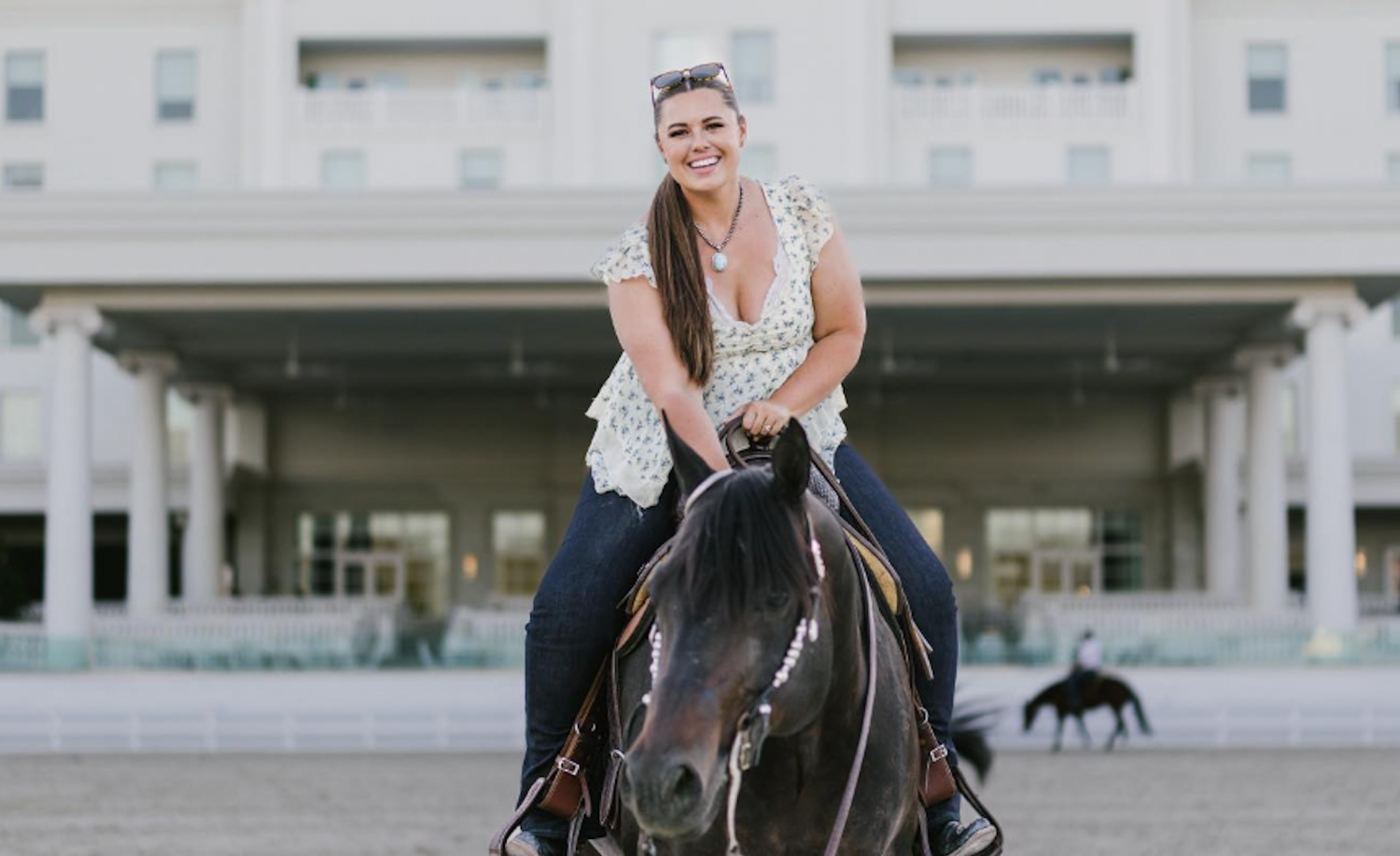
Hi y'all, Katie Van Slyke here! Horse riding for beginners can feel equal parts exciting and terrifying, and I get it. The first time you sit in a saddle and that horse starts moving underneath you, it's a whole new world.
Today, I'll walk you through what to wear, what happens before you even mount up, what it feels like in the saddle, and all the things I wish someone had told me before my very first ride.
Whether you're booking a trail ride or starting lessons, stick with me.
Before You Show Up: How to Prepare
What to Wear for Your First Time Riding a Horse
What you wear matters more than you think. Here's the simple checklist:
- Long pants. Jeans or riding breeches are ideal. The saddle will rub against your legs, and shorts will leave you chafed and uncomfortable fast.
- Closed-toe shoes with a small heel. Cowboy boots or paddock boots are perfect. The heel keeps your foot from sliding through the stirrup. Never wear sandals, flip-flops, or sneakers with thick, grippy soles.
- A fitted shirt. Nothing too loose or flowy that could catch on the saddle or tack.
- No scarves, dangling jewelry, or purses. Anything that can get tangled in reins or caught on equipment is a hazard.
- A helmet. Most lesson barns and trail operations provide helmets, and I strongly recommend wearing one, especially as a beginner. Safety first, always.
For weather: bring sunscreen and a hat (with a chin strap if riding) on sunny days. In cooler weather, dress in layers you can tie around your waist. And always bring water.
Choose the Right Setting
For your first time riding a horse, you want a structured, guided environment. That means either:
- A lesson barn with a certified instructor who works with beginners. This is the best option if you want to actually learn to ride.
- A guided trail ride at a stable that caters to beginners. These are great for a first experience because the horses are calm, the routes are easy, and a guide is with you the entire time.
I started riding as a kid on the family farm, so my "first ride" was probably on a lead line at age three. But for someone coming to this fresh, a lesson barn with patient instructors and well-trained school horses is the way to go. We've got more on that in our post about what to expect at beginner riding lessons.
Call the barn ahead of time and tell them you've never ridden before. Good barns will match you with their calmest, most experienced horse and give you extra attention during your first session. There's no shame in being a beginner. Every rider started exactly where you are.
What Happens Before You Get on the Horse

Your first ride doesn't start in the saddle. It starts on the ground. Here's what to expect when you arrive at the barn:
Meeting Your Horse
You'll be introduced to the horse you'll be riding. Take a moment to say hello. Let the horse sniff your hand. Pat them gently on the neck or shoulder. Talk to them in a calm, relaxed voice. Horses are incredibly sensitive to energy, and the calmer you are, the calmer they'll be.
Don't worry if the horse seems big. They're supposed to be! Most lesson horses are chosen specifically for their gentle, patient temperament. They've carried hundreds of beginners and they know the drill.
Groundwork and Tacking Up
Depending on the barn, you might help groom your horse and put on the tack (saddle and bridle). This is actually one of the best parts because it's where you start building a connection with the horse before you're even in the saddle. You'll learn how to approach, how to brush, and how the equipment works.
If you're on a guided trail ride, the staff will usually have the horse already tacked up and ready for you.
Getting in the Saddle: What Your First Ride Feels Like
Mounting Up
Your instructor or guide will show you how to mount (get on the horse). The standard method is to stand on the horse's left side, put your left foot in the stirrup, grab the saddle horn (Western) or the front of the saddle (English), and swing your right leg over.
It takes a little coordination, and a mounting block (a step platform) makes it much easier. Don't be embarrassed to use one. I use mounting blocks all the time. Once you're up, you'll sit down into the saddle, and your instructor will adjust your stirrups so your legs are at the right length.
The First Few Steps
Here's the moment everyone remembers. The horse takes that first step, and you feel the ground moving underneath you. It's a rocking, swaying motion that feels completely foreign at first. That's normal! Your body is learning a new kind of balance.
The key things to focus on:
- Sit up tall. Shoulders back, chin up, eyes forward (look where you're going, not down at the horse).
- Keep your heels down. Push your weight into your heels in the stirrups. This anchors you and gives you stability.
- Relax your body. If you tense up, you'll bounce. If you relax, you'll move with the horse. Think of your hips gently following the horse's rhythm.
- Hold the reins gently. You don't need a death grip. Light, steady contact is all it takes.
- Breathe. Seriously. A lot of first-time riders hold their breath without realizing it. Breathe in, breathe out, and let your body settle.
Falling in love with horses? Welcome to the club! Check out our Katie's Classics for farm-life merch that celebrates the everyday magic of being around horses.
Walking and Steering
Your first time riding a horse, you'll probably spend most of the ride at a walk. And that's perfect. The walk is a four-beat gait, meaning each hoof hits the ground separately. It's the slowest, smoothest, and most comfortable gait.
To steer, you'll use a combination of rein pressure and leg cues. Your instructor will walk you through it. In Western riding, you often "neck rein," which means laying the rein against the horse's neck to turn. In English riding, you use a direct rein. Don't overthink it; your instructor will tell you exactly what to do.
To stop, sit deep in the saddle, say "whoa," and gently pull back on the reins. Most lesson horses respond quickly to voice cues.
You Might Trot (and That's Where It Gets Bouncy)
If your instructor thinks you're ready, you might try a trot (called a "jog" in Western riding). The trot is a two-beat gait where diagonal pairs of legs move together. It's faster than a walk and, fair warning, it's bouncy.
The key to surviving the trot as a beginner is learning to post: rising slightly out of the saddle and sitting back down in rhythm with the horse's movement. It takes practice, and your first attempts will feel awkward. That's okay. Everybody's first trot is a little chaotic.
What to Expect After Your First Ride

You Will Be Sore
I'm going to be honest with you: you will feel muscles you didn't know you had. Horseback riding works your inner thighs, core, lower back, and glutes in ways that most everyday activities don't. The soreness usually peaks the day after your ride.
Stretching before and after your ride helps a lot. Focus on hip flexors, inner thighs, and hamstrings. And drink plenty of water. You'll recover faster with each ride as those muscles adapt.
You Might Feel Addicted
There's something about that first ride that hooks people. The feeling of connection with the horse, the rhythm of the movement, the view from the saddle, it's unlike anything else. A huge percentage of the people who follow me online got into horses as adults after their first trail ride or lesson. Horse riding for beginners is genuinely one of the most rewarding things you can try.
I show on the AQHA circuit now, competing in Western Pleasure, Equitation, Horsemanship, and more. But I'm still learning every single day. The best riders are the ones who never stop being students. Your first ride is just the beginning of something awesome.
Common First-Ride Mistakes (and How to Avoid Them)
- Gripping with your knees. New riders clamp down with their legs because it feels safer. It actually pushes you up and out of the saddle. Relax your legs and let your weight drop through your heels.
- Looking down at the horse. Your eyes should be up, looking where you're going. Looking down throws off your balance and makes the horse unsure of your direction.
- Pulling too hard on the reins. The reins are for communication, not for hanging on. If you need to feel secure, hold the saddle horn or the front of the saddle, not the reins. Pulling on the horse's mouth is uncomfortable for them.
- Holding your breath. Tension in your body transfers directly to the horse. Breathe. Talk to your horse. Hum a song. Anything to keep you relaxed.
- Wearing the wrong shoes. I've seen people show up in flip-flops. Please don't. Closed-toe, small heel. That's all it takes.
What Horseback Riding for Beginners Looks Like Long-Term
If your first ride leaves you wanting more (and it probably will), here's a rough idea of what progress looks like with regular weekly lessons:
- First few lessons: Walking, steering, stopping. Learning to groom and tack up. Getting comfortable in the saddle.
- Months 1 to 3: Trotting and posting. Basic arena exercises like circles, serpentines, and transitions between walk and trot.
- Months 3 to 6: Introduction to the canter/lope. More independent control of the horse. Starting to work on your position and balance at faster speeds.
- Months 6 to 12: Refining your riding. Smoother transitions, better communication with the horse, and possibly starting to work over small jumps (English) or pattern work (Western).
Everyone's timeline is different, and there's no rush. The gear and techniques will come with time. The most important thing is to enjoy the process and keep showing up.
Ready to dive into the horse world? Browse our newest arrivals at the Running Springs store for fresh designs celebrating everything equestrian.
Shop Running Springs
Whether you just took your first ride or you've been in the saddle for years, the Running Springs store has something for every horse lover. Our Katie's Classics are the everyday go-tos, and there's always something new dropping. Come take a look.
Shop All Running Springs Merch
Your First Ride Is Just the Beginning
Horse riding for beginners is one of those rare experiences that's both humbling and empowering at the same time. You're learning to communicate with a 1,000-pound animal using nothing but your body, your voice, and a whole lot of trust. It's wild. It's beautiful. And once you start, you'll never look at the world the same way.
I've been around horses my entire life, and I'm still learning new things every day. So wherever your first ride takes you, know that the whole horse community is cheering you on. Including me.
Thanks for reading, y'all. If you've got first-ride stories (or questions before your first ride!), come find me on TikTok, YouTube, and Facebook. I love hearing these stories.
Frequently Asked Questions About First-Time Horseback Riding
Is horseback riding hard for beginners?
It's a new skill, so it takes some getting used to, but it's not as hard as most people expect. Lesson horses are specifically trained to be calm and forgiving with new riders. The biggest challenge for most beginners is relaxing their body and finding their balance. With a good instructor, you'll feel comfortable surprisingly fast.
How long is a typical first ride?
A first lesson usually lasts 30 minutes to an hour. Guided trail rides for beginners typically run one to two hours. For a first-timer, even 30 minutes is enough to get a real feel for what horseback riding is like.
Will I gallop on my first ride?
No, and you shouldn't want to! Your first ride will be at a walk, and maybe a trot if your instructor feels you're ready. Galloping is an advanced skill that takes months (or longer) to develop safely. Walking is plenty exciting when it's your first time in the saddle.
How sore will I be after my first ride?
Most first-time riders feel moderate soreness in the inner thighs, hips, and lower back the day after. It's similar to the soreness after trying a new workout. Stretching before and after helps a lot, and the soreness decreases each time you ride.
Can I ride a horse if I'm afraid of them?
Absolutely. Many people start with a healthy amount of nervousness, and that's completely normal. A good lesson barn will pair you with their calmest horse and an instructor who knows how to work with nervous beginners. Being a little scared doesn't mean you can't ride; it just means you're taking it seriously, which is a good thing.
About the author

Hi, I am Katie Van Slyke, and I share my daily life at Running Springs farm with millions of wonderful people online. I am best known for raising a huge variety of animals, from Quarter horses to famous mini Highland cows.
My true expertise lies in hands-on animal husbandry and living an authentic Tennessee outdoor lifestyle. I love bringing my everyday farm adventures and practical experience straight to you!














1 comment
Hi!! I stumbled across your Facebook Reels earlier this month, and I absolutely LOVE watching them! The foals are the cutest, and their mommas are just as adorable.
Learning to ride a horse has always been on my bucket list, and today I found your blog through the link to your Running Springs sweatshirt. I ended up reading your post about first-time riders, and it was exactly what I needed. Your tips and explanations about what to expect really helped calm some of those anxious first-timer nerves.
Do you ever offer private riding lessons? 😊 I’d honestly fly from Austin, TX for a lesson with you! Thanks for creating such fun, informative content—I can’t wait to keep following along with your journey and all the adorable horses!