
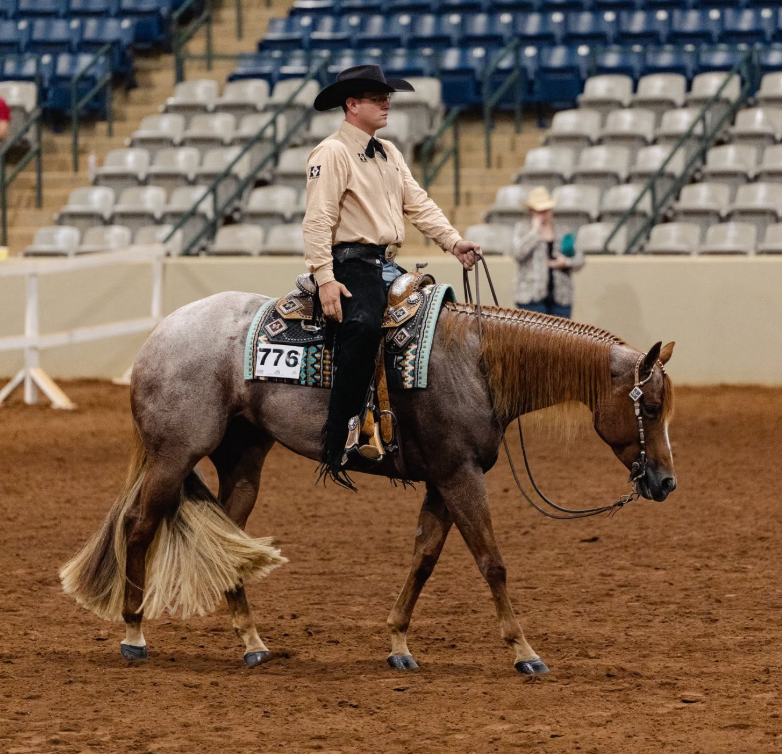
I've watched my stallion First Thingz First, Denver, work a clean three-beat lope all the way to Reserve 3-Year-Old Pleasure Versatility Champion at the 2024 AQHA World Show, and the difference between a correct lope and a horse about to break into a gallop is the first thing I look for from the rail.
A canter is a three-beat gait, and a gallop is a four-beat gait that happens when the canter opens up all the way. They look similar from a distance, but the mechanics, speed, and purpose are different.
Today I'll break down what each gait is, how to tell them apart, when riders ask for each, and how it all shows up here at Running Springs. Stick with me.
Quick Comparison: Canter vs Gallop at a Glance
Before we dig into the mechanics, here is the side-by-side version:
| Feature | Canter (Lope in western) | Gallop |
|---|---|---|
| Rhythm | 3-beat | 4-beat |
| Average speed | 10-17 mph | 25-30 mph (40+ for racehorses) |
| Primary use | General riding, showing, training | Racing, open-field, emergencies |
| Stride extension | Moderate | Fully extended |
| Suspension phase | Yes (brief) | Yes (long, floaty) |
| Used in show pen? | Almost every discipline | Mostly racing & eventing only |
The headline difference is rhythm. The canter is a clean three-beat gait. The gallop is a four-beat gait that happens when the canter opens up and the diagonal pair breaks apart. Everything else flows from that single mechanical change.
What Is a Canter?

The canter is a three-beat, medium-speed gait. It is the gait most commonly used in pleasure riding, training, and almost every show discipline. At the canter, the horse moves in a deliberate, rolling rhythm:
- Beat one: the outside hind leg strikes the ground.
- Beat two: the inside hind and outside front land together as a diagonal pair.
- Beat three: the inside front (the leading leg) reaches forward and lands last.
- Suspension: all four feet briefly leave the ground before the next stride begins.
Average canter speed runs about 10 to 17 mph. The exact pace depends on the horse, the discipline, and the rider's intent. A collected canter might sit closer to 10 mph, while an extended canter pushes toward 17.
In western riding, this same gait is called a lope, and it is generally slower and lower than the english canter.
What Is a Gallop?

The gallop is the fastest gait a horse can produce. It is essentially what happens when you let the canter open up, the rhythm breaks from three beats into four, and each leg lands independently.
The gallop sequence:
- Beat one: outside hind leg.
- Beat two: inside hind leg.
- Beat three: outside front leg.
- Beat four: inside front (the leading leg).
- Suspension: all four feet leave the ground before the cycle restarts.
Average gallop speed runs 25 to 30 mph in a general riding context. Racehorses gallop significantly faster.
Thoroughbreds reach about 35 to 40 mph at peak race pace, and the legendary Secretariat still holds the 1973 Belmont Stakes record, covering the mile and a half in 2:24 at an average of roughly 37.5 mph.
The gallop fully extends the horse's spine, lengthens the stride, and brings the front and hind legs further apart in midair. It is the gait you see on the racetrack, in cross-country, and in any "open up and run" moment on the trail or in the pasture.
Every Quarter Horse foal we welcome at Running Springs carries the genetics of the breed bred for explosive short-distance speed. Browse our foals collection for apparel that celebrates the next generation.
Canter vs Gallop: The 3-Beat vs 4-Beat Difference
The single biggest mechanical difference between cantering and galloping is the breaking of the diagonal pair.
In the canter, the inside hind and outside front land at the exact same time. That shared landing is what makes the canter a three-beat gait, the diagonal pair counts as a single beat.
In the gallop, the horse picks up speed and that diagonal pair separates. The inside hind hits the ground a fraction of a second before the outside front. That tiny delay turns three beats into four.
This is also why some old-school horsemen call a four-beat lope "broken" or "incorrect." In the western pleasure show pen, judges want a clean three-beat lope.
A four-beat lope means the horse has started transitioning mechanically toward the gallop, which is penalized in pleasure classes. For more on the vocabulary that comes up in conversations like this one, our piece on horse breeding terms is the place to start.
Speed is the easy answer most beginners give for the difference between the two gaits. But speed alone is not what defines them. A slow gallop and a fast canter can land at similar mph numbers. The defining feature is the rhythm, not the pace.
Want to understand how all the main horse gaits compare? Our guide to horse gaits breaks down the walk, trot, canter, gallop, and more.
The Moment of Suspension in Both Gaits

Both the canter and the gallop include a moment of suspension. That is the stride where all four feet leave the ground at the same time. It is the springboard that lets the horse cover so much ground in a single stride.
In the canter, the suspension phase is shorter and feels like a smooth, rolling bounce in the saddle.
In the gallop, the suspension phase is much longer and more dramatic. The horse fully extends mid-air, almost flying between strides. It is one of the most beautiful things to watch in slow motion, and one of the most exhilarating things to feel as a rider.
When Riders Use Each Gait
Different gaits serve different purposes for both the horse and the rider.
The canter is used for:
- Almost every show discipline (Western Pleasure, Hunter Under Saddle, Dressage, Equitation)
- Trail riding at a comfortable forward pace
- Schooling figures, transitions, and lead work
- Teaching young horses balance and forward motion under saddle
- Lower-level eventing (dressage and show jumping phases)
The gallop is used for:
- Flat racing (Thoroughbreds, Quarter Horses)
- Cross-country phases in eventing
- Steeplechase and point-to-point racing
- Conditioning work for racehorses
- Wide-open trail riding or pasture turnout
Most amateur and pleasure riders spend the vast majority of their saddle time at the canter, not the gallop. A controlled gallop in an arena is possible, but the gait is most at home in open ground with room to extend.
Behind every cantering Quarter Horse is the stallion side of the family. Our stallions collection features Waylon (VS Code Red) and Denver, the two boys at the heart of our breeding decisions.
Lope vs Canter: Western Terminology Explained
If you grew up on western terms, "lope" is the word you know. If you grew up on english or british terms, "canter" is what you call it.
They are the same gait. The lope is just a slower, lower, more collected version of the canter, the way western pleasure riders train it. A reining horse's lope is closer to a true canter in terms of impulsion.
An english canter is generally more forward and round than a western pleasure lope.
The actual three-beat mechanics are identical. The horse, the footfalls, and the suspension are the same. Only the speed, frame, and discipline-specific style differ.
How to Visually Tell a Canter and a Gallop Apart
If you are watching a horse move and want to tell whether it is cantering or galloping, here is what to look for:
- Listen for the beats. A clean three-beat rhythm (one-two-three, one-two-three) is a canter. A four-beat (one-two-three-four) is a gallop.
- Watch the diagonal pair. If the inside hind and outside front land as one beat, it is a canter. If they are clearly separated, it is a gallop.
- Look at the spine. A galloping horse fully extends and contracts its back with each stride. A cantering horse moves with a more uniform, rolling rhythm.
- Check the head and neck. A gallop pumps the head and neck more dramatically as the horse drives forward.
- Watch the suspension phase. A canter's suspension is brief. A gallop's is long and floaty.
Watching slow-motion video is the fastest way to train your eye for the difference. Once you have seen it, you will start spotting it in every video and trail ride.
When Does the Canter Become a Gallop?
There is no exact speed where the canter becomes a gallop. The transition is gradual and is defined by the rhythm change, not the speed.
In a typical transition:
- The horse is cantering in a clean three-beat rhythm.
- The rider asks for more speed, or the horse picks up speed on its own.
- As the horse extends, the diagonal pair starts to break apart.
- The third beat (which was the diagonal pair as one) separates into two distinct beats.
- The horse is now galloping.
A trained rider can sometimes feel this happen mid-stride. The rhythm changes from a clean three to a slightly faster four under the saddle.
In western pleasure, this is exactly the unwanted transition that judges penalize. In open-field riding or racing, it is the entire point.
Cantering and Galloping at Running Springs
At Running Springs, both gaits play a role across our program, but they show up in very different ways across the barn.
Our Quarter Horses are bred to lope. The breed name itself, "Quarter Horse," comes from their ability to sprint a quarter mile faster than any other breed on earth.
They are explosive over short distances, which is why Quarter Horse racing is its own discipline, but in the show pen they are asked to lope, not gallop.
A clean, three-beat lope is what wins in Western Pleasure, Hunter Under Saddle, Horsemanship, and the rest of the all-around classes I show in on the AQHA circuit as a non-pro.
Our broodmare Indy is a Thoroughbred, and Thoroughbreds are bred for the gallop. Their long stride, deep chest, and aerobic conditioning make them the dominant racing breed and one of the most efficient galloping animals on earth.
Her foals carry that gallop-built genetics into a Quarter Horse breeding program, which is where the Appendix Quarter Horse (Quarter Horse x Thoroughbred) comes from.
The boys, VS Code Red and Denver, both have an industry-leading lope that helped earn them their show records.
Denver was the Reserve 3-Year-Old Pleasure Versatility Champion at the 2024 AQHA World Show, and VS Code Red is a Congress Champion and four-time NSBA World Champion. The full Running Springs roster, broodmares and show stock alike, lives in our meet the herd post.
The Running Springs everyday, barn boots, coffee, and a baby horse around every corner, lives in our Classic Apparel collection.
If you want more from the farm, come follow along on Facebook, Instagram, TikTok, and YouTube.
The Bottom Line on Canter vs Gallop
The canter and the gallop are two sides of the same coin. They share footfalls, they share suspension, and they share the heart of what makes horse riding addictive. But they are not the same gait.
The canter is the workhorse of trained riding. The gallop is the wild release. Knowing the difference makes you a better rider, a better observer of horses, and a better student of the sport.
Whether you grew up loping in a western saddle or cantering english, the same biomechanics sit underneath. Once you can tell them apart by ear, by eye, and by feel, you will see the difference everywhere, in the show pen, on the racetrack, and in every wide-open run across the pasture.
Frequently Asked Questions About Canter vs Gallop
What is the main difference between a canter and a gallop?
The main difference is rhythm. The canter is a three-beat gait where the inside hind and outside front land together as a diagonal pair. The gallop is a four-beat gait where that diagonal pair separates and each leg lands independently. The gallop is also significantly faster.
Is a gallop faster than a canter?
Yes. A canter typically runs 10 to 17 mph. A gallop typically runs 25 to 30 mph. Racehorses gallop faster still, with Thoroughbreds reaching about 35 to 40 mph at peak race pace.
Is a lope the same as a canter?
Yes. Lope is the western term for canter. Mechanically they are identical three-beat gaits. The lope is generally slower, lower, and more collected than an english canter, but the footfalls and suspension phase are the same.
Do both the canter and gallop have a suspension phase?
Yes. Both gaits include a moment of suspension where all four of the horse's feet leave the ground at the same time. The suspension phase is much more pronounced in the gallop than in the canter.
Why is a four-beat canter considered incorrect?
In western pleasure and most show disciplines, a clean three-beat lope is required. A four-beat lope means the horse has lost the diagonal pair and started to break toward a gallop rhythm mechanically. Judges penalize this in the show pen because it shows a loss of collection and proper canter form.
Can a horse gallop on the wrong lead?
Yes, but it is uncomfortable and unbalanced for the horse, especially through turns. Most racehorses are trained to change leads at specific points on the track to keep the inside lead matching the direction of travel.
About the Author

Hi, I am Katie Van Slyke!
I breed AQHA Quarter Horses at my family farm in Tennessee, stand two stallions, and document foaling season every year from the barn floor while sharing the daily realities of farm life.
I am incredibly lucky to share this journey with millions of friends across YouTube, TikTok, Facebook, and Instagram. You can read the full story of how it all started on my about page.
Sources
The biomechanics, speeds, and gait sequences in this article are drawn from published equestrian and veterinary resources. They are educational only and do not replace working with a qualified instructor or trainer.













0 comments