
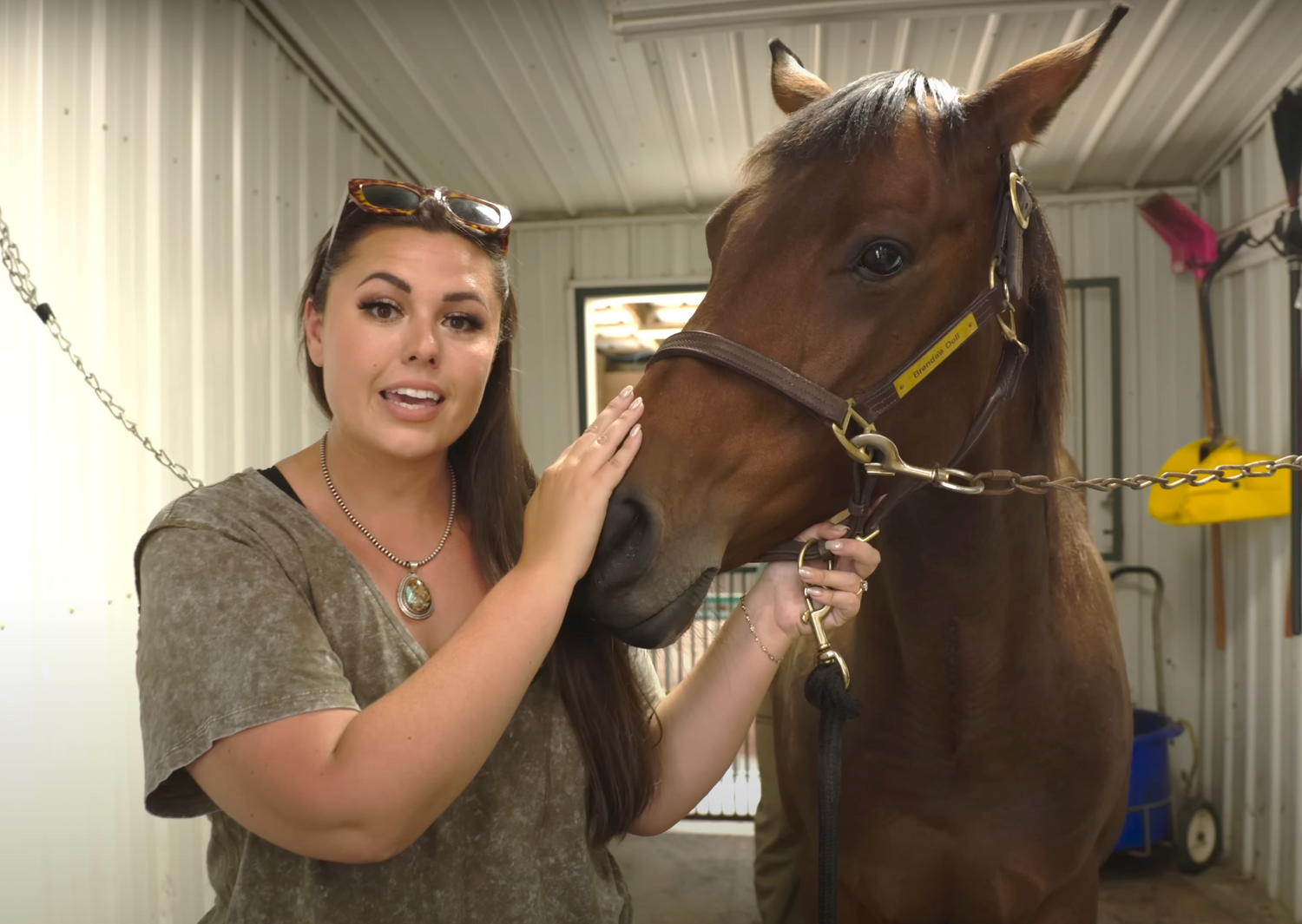
While horse breeding season has officially ended at Running Springs, our work continues with heartbeat checks for the mares.
These ultrasounds help confirm that each pregnancy is viable beyond the early stages, making it more likely the foal will carry to term.
- What is a horse ultrasound pregnancy check?
- The horse pregnancy ultrasound timeline
- When is the embryonic heartbeat first detected?
- Normal heart rate ranges for horses
- How to check your horse's heart rate by hand
- Why twin detection matters in horse breeding
- Early embryonic loss and why repeat ultrasounds matter
- What if no heartbeat is detected?
- Heartbeat checks at Running Springs: four mares, four stories
- The 2026 foaling lineup at Running Springs
- Why horse ultrasound pregnancy checks matter
- Frequently asked questions
What Is a Horse Ultrasound Pregnancy Check?
A horse ultrasound pregnancy check is the standard veterinary procedure used to confirm and monitor pregnancy in mares.
Most checks are performed via transrectal ultrasound, where the vet inserts a sterile ultrasound probe into the rectum to image the uterus directly through the bowel wall. The dark, fluid-filled embryonic vesicle shows up clearly on the screen, even at a stage when no other test would catch the pregnancy.
Later in gestation, vets may switch to transabdominal ultrasound, working through the mare's flank or belly. The choice depends on the stage of pregnancy and what the vet is looking for — confirmation, heartbeat, fetal sexing, or placental health.
These exams are part of routine broodmare management and the foundation of every responsible horse breeding program. They are also the only way to catch problems like twins, early embryonic loss, or a missed pregnancy early enough to do something about them.
Here's a video to show you how we do heartbeat checks at the farm:
The Horse Pregnancy Ultrasound Timeline
Most breeding farms run a multi-step ultrasound protocol over the first three to four months of pregnancy. Exact schedules vary by vet and program, but the standard timeline looks like this:
| Day post-ovulation | What the vet checks |
|---|---|
| Days 14-18 | First pregnancy confirmation. Critically, this is when the vet checks for twins. If twins are present, one is usually pinched at this stage so the surviving embryo and the mare can continue safely. |
| Days 25-30 | Heartbeat scan. The embryonic heartbeat is first visible around day 24-25. This scan confirms the pregnancy is viable and re-checks for twins. |
| Days 40-60 | Viability and development. Confirms continued growth, evaluates the placenta and corpus luteum, and watches for early embryonic loss, which is still common in this window. |
| Days 60-90 | Fetal sexing becomes possible via transrectal ultrasound around day 60. Sexing can also be attempted via transabdominal scan later in gestation. |
| Fall check | A final pregnancy confirmation before winter management begins. Many programs treat this as the last scan before foaling prep. |
Skipping early scans is a real risk. Twins missed at days 14-16 can be catastrophic. Early embryonic loss in the 25-60 day window is silent and the only way to catch it is with a scheduled re-check.
When Is the Embryonic Heartbeat First Detected?
The embryonic heartbeat is first visible on a transrectal ultrasound around day 24-25 of pregnancy, and consistently by day 28-30. Before that point, the conceptus is a small fluid-filled vesicle without a recognizable heartbeat flicker.
If a heartbeat is not detected at day 25, the vet usually does not call the pregnancy lost right away. The standard protocol is a re-check in 24 to 48 hours. A delayed but eventually present heartbeat is not unusual in mares.
By day 30, an absent heartbeat is a serious concern and typically means the pregnancy has been lost. This is why the heartbeat scan is one of the most emotionally heavy checks in a breeding season — it is the first hard confirmation that the embryo is alive and developing.
Normal Heart Rate Ranges for Horses
While the embryonic heartbeat is detected by ultrasound, knowing the normal heart rate ranges for horses at every life stage matters across the breeding program — and across daily horse care in general.
| Life stage | Normal resting heart rate |
|---|---|
| Adult horse | 28-44 bpm |
| Newborn foal | 80-120 bpm |
| Yearling | 40-60 bpm |
Larger breeds sit on the lower end of the adult range. Smaller horses and ponies tend to sit on the higher end. A resting heart rate above 64 bpm in an adult horse is a strong signal of pain, stress, or a serious medical issue and warrants a call to the vet.
Take a baseline when your horse is calm so you know what is normal for them specifically — that personal baseline is more useful than any chart.
How to Check Your Horse's Heart Rate by Hand
Outside of pregnancy ultrasound checks, every horse owner should know how to take a heart rate by hand. There are two common methods:
Using a stethoscope

Image source: SmartPak Equine
- Stand on the horse's left side.
- Place the chest piece behind the left elbow, pushed up and forward into the girth area as far as it will go.
- Listen for the "lub-dub" sound.
- Count each full "lub-dub" as one heartbeat.
Using your fingers (facial artery method)

Image source: TheHorse
If you do not have a stethoscope, use your pointer and middle fingers — never your thumb, which has its own pulse you might mistake for the horse's.
- Press gently against the large facial artery on the underside of the jawbone, just in front of the jowl.
- Move your fingers slightly forward and back until you feel the pulse.
Calculating beats per minute
Example: if you count 9 beats in 15 seconds, that's 9 × 4 = 36 bpm — right in the normal adult resting range.
For more on the everyday vocabulary of breeding and broodmare care, our piece on horse breeding terms every new breeder should know covers the basics that make ultrasound conversations easier.
Why Twin Detection Matters in Horse Breeding
Twin pregnancies in horses are dangerous. Most mares cannot carry twins to term safely, and twin pregnancies often end in late-term abortion of both foals or serious health complications for the mare.
That is why the day 14-16 ultrasound is non-negotiable in any responsible breeding program. At that stage, twin embryos can usually be identified and one can be pinched (carefully terminated) using the ultrasound probe. The remaining embryo continues to develop, and the mare carries a single, healthy foal to term.
Catching twins later — past day 16 — makes the reduction much more difficult, and past day 35 it often becomes unsafe to attempt at all. By that point, the only options are usually to let the pregnancy continue with a high risk of loss, or terminate both.
For more on how donor and recipient mares fit into a twin-safe breeding program, our piece on the role of recipient mares walks through how we manage embryo transfers at Running Springs.
Early Embryonic Loss and Why Repeat Ultrasounds Matter
Early embryonic loss is one of the hardest parts of horse breeding. The first 60 days of pregnancy are when most losses happen, and a mare who absorbs a pregnancy may show no outward signs at all.
This is exactly why scheduled re-checks matter so much. A mare who scanned pregnant at day 14 may be empty by day 30. Without that follow-up ultrasound, you would not know — and the breeding window may have already closed for the season.
Causes of early embryonic loss vary widely:
- Twin conception
- Hormonal imbalance, often progesterone-related
- Uterine infection or inflammation
- Maternal age and reproductive history
- Stress, transportation, or nutritional shortfalls
- Heat stress in summer breeding
Older mares lose pregnancies at significantly higher rates than younger, healthy mares. Mares with a history of "slipping" pregnancies are often put on supplemental progestin (altrenogest, sold as Regu-Mate) to help maintain the pregnancy through the high-risk early window.
Nutrition is one of the most controllable factors on this list. We run our entire broodmare band on Tribute Equine Nutrition for exactly this reason.
What If No Heartbeat Is Detected?
If your vet does not see a heartbeat on a day 25 ultrasound, do not assume the worst right away. The standard protocol is a re-scan in 24 to 48 hours, because delayed-but-present heartbeats happen.
If the re-check confirms no heartbeat, the pregnancy is considered lost. Depending on the mare's history, age, and the breeding plan, the vet may recommend hormone testing or treatment, supplemental progestin, or attempting to rebreed on the next cycle.
This is the kind of moment our broodmare Happy gave us during her 2026 heartbeat check — the panic, then the relief when the heartbeat finally appeared on screen. You will read her full story below, along with three other mares who each carried their own version of that moment.
Heartbeat Checks at Running Springs: Four Mares, Four Stories

This is where the educational content above meets the barn floor. Below are the four mares we checked this season, each with her own embryo, due date, and story.
For the full Running Springs roster of broodmares and breeding stock, see our meet the herd post.
We checked four mares today: Maggie, Phoebe, Annie, and Happy. They each have unique backgrounds and special embryos.
Maggie: Full Sibling to Kirby
Embryo Pairing: Kennedy x Machine Made
Due Date: April 10
Maggie is carrying an embryo from my mare Kennedy and the stallion Machine Made. This baby will be a full sibling to Kirby.
The heartbeat check showed a clear flicker on the ultrasound, confirming a healthy pregnancy. Maggie also has a caslicks in place, which helps prevent infections and keeps the pregnancy safe.
Phoebe: Honoring a Legendary Sire
Embyo Pairing: Kennedy x RL Best of Sudden
Due Date: April 8
Phoebe is a recipient mare carrying a very meaningful embryo. RL Best of Sudden recently passed away, making this baby even more special. ICSI allowed us to preserve his legacy with three final embryos.
After previously absorbing a pregnancy, Phoebe made me nervous, but to my relief, we found a heartbeat. Denver may soon have a full sibling.
Annie: Overcoming EPM to Become a Mama Again
Embryo Pairing: Annie x First Things First
Due Date: April 11
Annie was born and raised at Running Springs. After battling EPM at age three, she is now healthy and thriving. She's already had two stunning colts and is now carrying a foal by my young stallion, First Thingz First. Her heartbeat check was a success, and another Denver baby is on the way.
Happy: A Bit of a Scare, Then a Heartbeat
Embryo Pairing: Happy x First Thingz First
Due Date: April 11
Happy was a recipient mare last year and is now pregnant with her own baby. Initially, we couldn't see the heartbeat and had a moment of panic. But just when we were about to lose hope, there it was. Happy is expecting a Denver baby, making it three foals by First Thingz First in 2026.
Here's a sample of a foal's heartbeat check in our farm:
The 2026 Foaling Lineup at Running Springs
In total, we are expecting eight foals in 2026, a mix of in-house mares and recipient mares carrying embryos from some of the top genetics in the industry.
January Foal
Raven (Recipient Mare)
Embryo Pairing: Only Blue Couture x VS Code Red
Due Date: January 20
Only Blue Couture is a world and Congress champion, and this foal by VS Code Red is expected to be a showstopper.
February Foals
Indy
Pairing: Indy x VS Code Red
Due Date: February 7
Indie, our only Thoroughbred broodmare, consistently foals on time and is carrying her third foal by VS Code Red.
Charlotte (Recipient Mare)
Embryo Pairing: Trudy x First Thingz First
Due Date: February 12
Charlotte was rescued from a kill pen and has spent the last year recovering and building trust. This will be her first foal and our first Trudy x Denver pairing.
March Foal
Recipient Mare (Not Yet Arrived)
Embryo Pairing: Waffle House x VS Code Red
Due Date: March 12
Waffle House is still showing in Texas, and her embryo is being carried by a recipient mare who will be joining us soon. This is Waffle House's first foal and another exciting VS Code Red baby.
April Foals
Phoebe (Recipient Mare)
Embryo Pairing: Kennedy x RL Best of Sudden
Due Date: April 8
Maggie (Recipient Mare)
Embryo Pairing: Kennedy x Machine Made
Due Date: April 10
Annie
Pairing: Annie x First Thingz First
Due Date: April 11
Happy
Pairing: Happy x First Thingz First
Due Date: April 11
While Annie tends to foal right on time, Happy usually foals early, so she might deliver first despite having the same due date.
Looking Ahead: A Year Full of Promise
We are expecting:
- Three foals by First Thingz First (aka Denver)
- Three foals by VS Code Red
- One by RL Best of Sudden
- One by Machine Made
Each pregnancy represents a meaningful step in our horse breeding program at Running Springs. From legacy sires to rescued mares, this lineup blends heart and heritage.
Why Horse Ultrasound Pregnancy Checks Matter

Every foal we welcome at Running Springs starts with a heartbeat on a screen. The horse ultrasound pregnancy check is more than a vet visit. It is the moment we know a breeding decision worked, the moment we know a mare is safely on her way, and sometimes the moment we have to face that things did not go the way we hoped.
That is why the schedule matters. The day 14 scan. The day 25 heartbeat. The 60-day check. Each one catches a different kind of risk and protects both the mare and the foal. The mares cannot tell you they are losing the pregnancy. The ultrasound can.
If you are running your own breeding program, build a relationship with a vet you trust, scan on a schedule, and do not skip the rechecks.
If you are watching from the outside, following along through every foaling season at Running Springs — thank you. Every one of these eight 2026 pregnancies is part of a bigger picture, alongside the rest of the herd we share with y'all.
For the foals from this lineup as they grow and become available, our horse and cattle sales page is the place to keep an eye on.
Frequently Asked Questions About Horse Ultrasound Pregnancy
What is a horse ultrasound pregnancy check?
A horse ultrasound pregnancy check is a veterinary exam where a sterile ultrasound probe is used (usually transrectally) to image the mare's uterus and confirm pregnancy. The same exam is used at later stages to check for twins, detect the embryonic heartbeat, monitor fetal development, and sex the foal.
When can a vet detect a horse's heartbeat on ultrasound?
The embryonic heartbeat is first visible on a transrectal ultrasound around day 24-25 of pregnancy and is consistently detectable by day 28-30. If no heartbeat is seen at day 25, vets typically re-check 24 to 48 hours later before calling the pregnancy lost.
How often should a pregnant mare be ultrasounded?
A typical schedule is four to five scans in the first 90 days: days 14-18 (initial confirmation and twin check), days 25-30 (heartbeat), days 40-60 (development), days 60-90 (sexing if desired), and a final fall check. Some programs add more scans depending on the mare's history.
What is the normal heart rate for an adult horse?
A healthy adult horse at rest typically has a heart rate between 28 and 44 beats per minute. Newborn foals run 80-120 bpm, and yearlings 40-60 bpm. A resting heart rate above 64 bpm in an adult horse is a sign of pain, stress, or a medical issue.
Can you check a horse's heartbeat without a stethoscope?
Yes. Press your pointer and middle fingers (never your thumb) against the large facial artery on the underside of the jawbone, just in front of the jowl. Count beats for 15 seconds and multiply by four to get beats per minute.
Why are twin pregnancies dangerous in horses?
Mares are not built to carry twins. Most twin pregnancies end in late-term abortion of both foals or serious health complications for the mare. This is why the day 14-16 ultrasound, where one twin can still be safely pinched, is one of the most important scans in any horse breeding program.
Keep Reading
If horse breeding and foaling season is on your mind, these next reads from Running Springs are a natural place to head.
- Placenta care after foaling — what happens once the pregnancy you ultrasounded becomes a foal on the ground.
- Broodmare bump dates and what to expect — how we track each pregnancy through the months that follow.
- The essentials for foaling season — the gear, the watch routine, and what we stock in the barn.
- 2026 foaling season preview — the broodmares, the sires, and what we are watching for.
- Breeding season insights from Running Springs — how the decisions you make months ago shape the foaling you get.
Sources
The pregnancy ultrasound timelines, heartbeat detection windows, and adult horse heart rate ranges in this article are drawn from published veterinary and university extension resources. They are educational only and do not replace the advice of your own veterinarian.
About the Author

Hi, I am Katie Van Slyke!
I breed AQHA Quarter Horses at my family farm in Tennessee, stand two stallions, and document foaling season every year from the barn floor while sharing the daily realities of farm life.
I am incredibly lucky to share this journey with millions of friends across YouTube, TikTok, Facebook, and Instagram. You can read the full story of how it all started on my about page.















2 comments
Katie,you perform a remarkable job in breeding and foaling.Negative comments are from people who do not understand what you do and are jealous.You put safety first and caring and that is what counts! Keep up the good work!
Like any little girl I dreamed of having horses. I never had the opportunity but, I am so enjoying learning so much and seeing all you do at Running Springs. I need to learn more about the types of horse classes but Katie, your videos and pictures make my day. Thank you, your beautiful family and employees at Running Springs.