
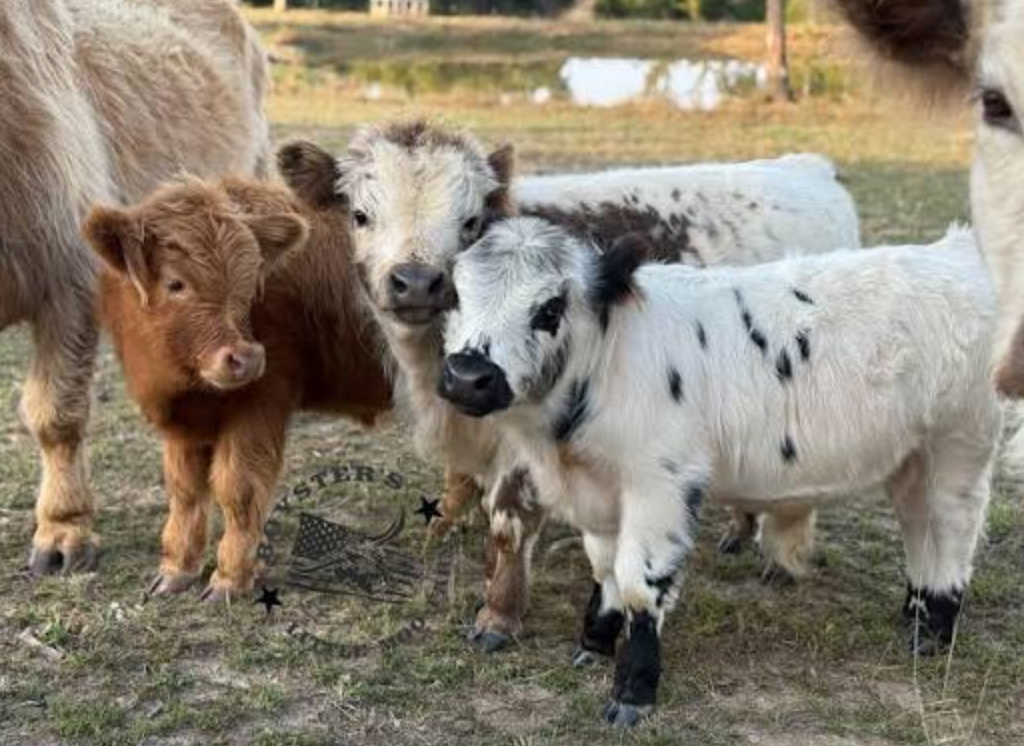
Miniature cow care comes down to five things: real pasture and a dry, three-sided shelter, fencing that's sturdy rather than tall, a forage-first diet of grass and hay, at least one herd companion, and a standing relationship with a large-animal vet for hoof trims and checkups. They're small, but they're still full livestock, and skipping any one of those basics catches up with you fast.
At Running Springs, our eight mini Highlands follow this same basic routine, day in and day out. Here's what it actually looks like once the cute-calf phase wears off and you're doing this for years, not weeks.
I've been raising mini Highland cows at Running Springs since Poppy and Petunia joined the herd as tiny calves three years ago, and I started breeding minis myself for the first time in the summer of 2025.
Key Takeaways
- Plan on real pasture and a dry, three-sided shelter, not just a fenced-in yard.
- Never keep a mini cow alone. Isolation is genuinely stressful for them.
- Diet is grass and hay first. Grain is the occasional exception, not the rule.
- Hoof trims on a fixed schedule are mainly a dairy-cattle convention. For a beef or heritage breed like a mini Highland, regular hoof checks matter more than a calendar date.
- Fencing needs to be sturdy, not necessarily tall. Minis test weak spots.
- Get on a large-animal vet's client list before you actually need one.
How Much Space and Shelter a Mini Cow Actually Needs

A mini cow needs meaningfully less land than a full-size animal, but "meaningfully less" still means real acreage, not a backyard pen. The International Miniature Cattle Breeders Registry notes it takes roughly five acres to raise two full-size cattle, while that same five acres can support one to two minis per acre with a small breed, since minis eat only about a third as much as standard cattle.
That works out to two-and-a-half to five times the stocking density of full-size cattle, which is exactly why minis have become the more realistic option for smaller properties.
Shelter and Bedding
Cattle housing guidance from UNH Extension calls for an open-front, three-sided shelter with the open side facing away from prevailing wind, set on an elevated, well-drained site. That design keeps the shelter dry and blocks the worst of the wind and rain while still letting the animal come and go freely. Dry bedding inside matters just as much as the structure itself. A shelter that stays damp underfoot does more harm than no shelter at all.
Fencing That Actually Holds
Don't mistake small for harmless with fencing. Mini cows are stronger and more persistent than their size suggests, and they will find a gap. University of Maine Cooperative Extension guidance on permanent livestock fencing points to high-tensile wire (electrified or not) as the practical choice for cattle: it's generally more economical than other fence types and has a longer life expectancy.
Woven wire is an option too, but the same guidance describes it as best suited to smaller animals like sheep, goats, or hogs rather than cattle specifically. What doesn't work is anything flimsy enough to flex under a determined, several-hundred-pound animal leaning on it.
Running Springs note
Our herd has taught me that fencing gaps get found, not avoided. Walk your fence line at least once a season and fix small gaps before a cow finds them for you.
What Miniature Cows Eat
Diet deserves its own deep dive rather than a quick summary here, because "grass and hay" undersells how much the details matter (how much, at what life stage, and what to actually avoid).
Short version: forage is the base of the diet, hay fills in when pasture is short, and grain is a situational tool, not a daily habit. For the full breakdown, quantities by weight, and what never belongs in a mini cow's feed bucket, see our companion guide, What Do Mini Cows Eat?
Why Mini Cows Need Company, Not a Solo Life
Cattle are herd animals by nature, and that doesn't change because the herd is small. The Merck Veterinary Manual's behavior guidance is direct on this point: cattle are a gregarious species that synchronizes behavior within the group, and social isolation is a genuine stressor, one that shows up as vocalization and a faster heart rate. Practically, that means never keeping a single mini cow alone. Two is the real minimum, not a nice-to-have.
Our eight girls make this easy to see in action. Poppy and Petunia, the two originals, still travel as a pair. Pumpkin and Posie, our two-year-olds, are what I'd call extra spicy, and their energy plays off each other constantly. Peanut, Pearl, and Pepper, the yearlings, are proof that small size does not mean small personality, and Pippa, the newest addition to the herd, slotted into the group without missing a beat. Watching how they pair off and reorganize themselves day to day is half the fun of having more than one.
A Seasonal Care Checklist
Care doesn't stay the same all year. Here's how the workload shifts by season in our own routine at Running Springs.
| Season | What changes |
|---|---|
| Spring | Pasture greens up fast. We introduce it gradually if the herd has been on hay all winter, and use the changeover as a good excuse for the year's first hands-on hoof check. |
| Summer | Grass carries most of the diet. We watch shade access and water intake closely as it gets hot, since heat pushes water needs up fast. |
| Fall | Pasture growth slows. We start easing hay back into the routine before the grass actually runs out rather than after. |
| Winter | Hay becomes the main forage source. Shelter and dry bedding matter most now, and we check water more than once a day since it can freeze over. |
Health, Grooming, and Hoof Care

Line up a large-animal or livestock veterinarian before you need one, not after. Regular brushing does double duty: it builds trust with the animal and gives you a chance to spot ticks, minor injuries, or skin issues early. We turned one of our own grooming sessions into a full walkthrough of what a pampering day at Running Springs looks like, if you want to see the routine in practice.
For hooves, it helps to know the fixed-schedule trim you'll read about online is mostly a dairy-cattle practice. The Merck Veterinary Manual notes that dairy cattle typically get hooves inspected and trimmed every 4 to 6 months as routine maintenance, while in beef cattle, hoof trimming isn't a routine practice at all and is used mainly to treat a problem once it shows up.
A mini Highland sits closer to the beef side of that line, so what actually matters more than a calendar is checking hooves by hand during grooming and calling a farrier or vet at the first sign of overgrowth, cracking, or a change in how the cow is walking.
Watch for these red flags and call your vet if you see them, the same list I go through with our own herd:
- Limping or reluctance to bear weight on a leg
- Off feed for more than a day, or a sudden drop in water intake
- Labored or unusual breathing
- Noticeable weight loss or a dull, rough coat
- Swelling anywhere, especially around a hoof or joint
Meet the Herd at Running Springs
Running Springs is our family farm in Nolensville, Tennessee, and mini Highlands are one of the categories that put us on the map. We keep eight of them: Poppy and Petunia, the originals who went viral a few years back and are still the faces of our mini cow merch line; Pumpkin and Posie, our extra-spicy two-year-olds; Peanut, Pearl, and Pepper, the yearlings; and Pippa, our newest addition. In the summer of 2025, I bred minis on our own property for the first time, using CIDRs to synchronize the herd's cycle, a process I documented publicly as it happened.
If you want more from the farm, come follow along on Facebook, Instagram, TikTok, and YouTube. And if you want to take a piece of the herd home with you, our Poppy and Petunia merch collection features designs inspired by our two originals.
The Bottom Line on Miniature Cow Care
Miniature cow care is livestock care, just scaled down. Real pasture, a dry three-sided shelter, sturdy fencing, forage-first feeding, herd companionship, and a vet relationship for hooves and health cover the fundamentals. None of it is complicated, but all of it is ongoing, and the animals notice when a piece gets skipped.
If you're still deciding whether a mini cow is right for your place at all, our full ownership guide is the better starting point, and our owner's cost breakdown covers the budget side. If you've already got one and want the unfiltered version of what daily life actually looks like, read what owning mini Highlands is really like. Either way, you'll know exactly what you're signing up for.
Frequently Asked Questions About Miniature Cow Care
How much land do you need per miniature cow?
Plan on roughly half an acre to a full acre per mini cow as a starting point, though it depends heavily on your pasture quality. The International Miniature Cattle Breeders Registry notes that on land where two full-size cattle would need about five acres, you can typically keep one to two minis per acre instead, since they eat roughly a third as much.
Can you keep just one miniature cow, or do they need a companion?
Don't keep a mini cow alone. Cattle are herd animals, and social isolation is a real stressor that shows up as vocalization and a faster heart rate. Two is the practical minimum.
What do miniature cows eat day to day?
Mostly pasture grass and hay, with fresh water always available and loose minerals on offer. Grain is situational, not a daily requirement. We cover exact quantities and what to avoid in a dedicated feeding guide.
How often do miniature cows need their hooves trimmed?
There's no fixed calendar for it. The 4 to 6 month schedule you'll see online is really a dairy-cattle practice. For a beef or heritage breed like a mini Highland, hoof trimming isn't routine, it's done as needed, so a hands-on check during regular grooming and handling matters more than sticking to a date.
What kind of shelter does a miniature cow actually need?
An open-front, three-sided shelter, positioned so the open side faces away from prevailing wind, on ground that drains well. It doesn't need to be elaborate. It needs to be dry and to actually block wind and rain.
Is a miniature cow cheaper to keep than a full-sized cow?
Generally, yes, mainly because they need less land and less feed. We break down the real numbers in a dedicated cost article.
About the Author

Hi, I am Katie Van Slyke!
I breed AQHA Quarter Horses at my family farm in Tennessee, stand two stallions, and document foaling season every year from the barn floor while sharing the daily realities of farm life.
I am incredibly lucky to share this journey with millions of friends across YouTube, TikTok, Facebook, and Instagram. You can read the full story of how it all started on my about page.
Sources
General husbandry facts below come from veterinary, land-grant extension, and breed-registry sources; anything specific to Running Springs comes from Katie's own first-hand farm experience.
-
Merck Veterinary Manual, Behavior of Cattle
-
Merck Veterinary Manual, Components of a Hoof-Trimming Program in Cattle
-
UNH Extension, Housing and Space Guidelines for Livestock
-
University of Maine Cooperative Extension, Fencing Systems for Livestock
-
International Miniature Cattle Breeders Registry (IMCBR), The Advantages of Owning Miniature Cattle














0 comments