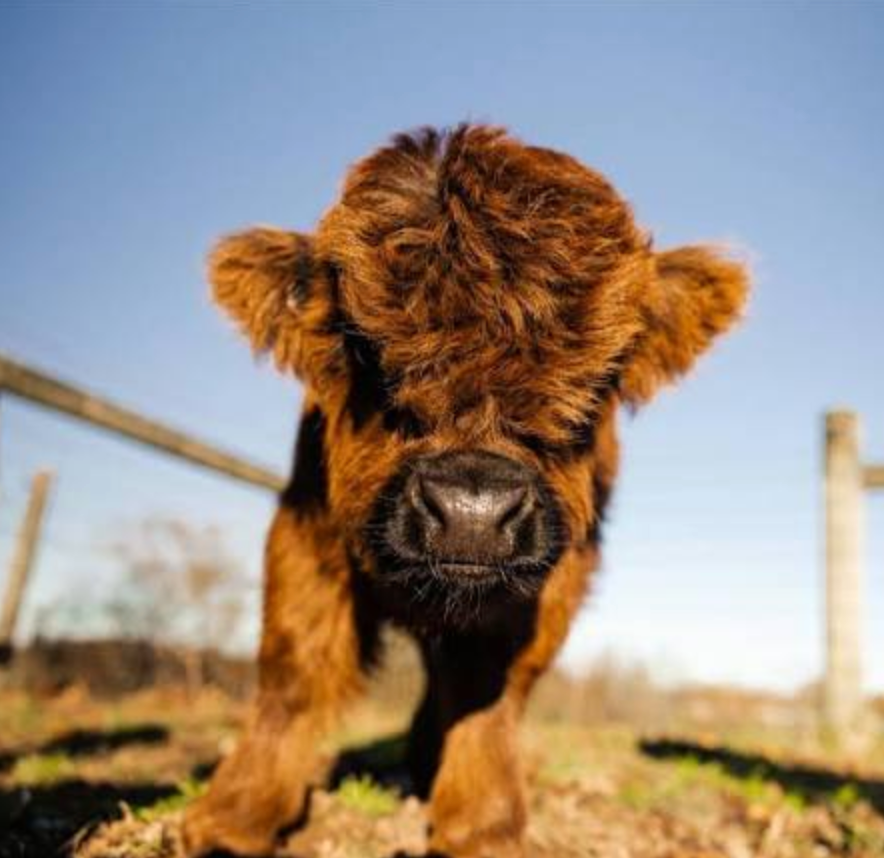
Hi y'all, Katie Van Slyke here! Few animals on the internet have melted more hearts than the fluffy cow breeds taking over everyone's feeds.
From our own mini Highland girls at Running Springs to the now-iconic "fluffy cow" trend that went viral over a decade ago, these shaggy, double-coated cattle have built a fan club that just keeps growing.
Today, I'll walk through what a fluffy cow really is, every breed that earns the nickname, why some cows are fluffier than others, and what it actually takes to bring one home. Stick with me.
Quick Answer: What Is a Fluffy Cow?
A "fluffy cow" is the popular nickname for any cattle breed with a long, thick, shaggy coat. The term most commonly refers to:
Scottish Highland cattle (the iconic red, brown, or black shaggy cows from Scotland) and their miniature versions. Other fluffy breeds include the Belted Galloway ("Belties"), Galloway, Welsh Black, and British White Park.
Many viral "fluffy cow" photos online are actually;show club calves — commercial beef cattle that have been bathed, blow-dried, and styled to look extra fluffy for livestock shows.
The Origin of the Fluffy Cow Trend

The fluffy cow obsession is older than you might think. According to Iowa Farm Bureau, the original viral "fluffy cow" actually wasn't a cow at all — it was a male show bull named Texas Tornado, photographed at the 2013 National Western Stock Show in Denver.
He was a commercial beef crossbreed raised by Lautner Farms in Adel, Iowa, and his fluffy, blow-dried coat went viral on Reddit and Today.com that year.
After Texas Tornado's moment, the internet's appetite for fluffy cattle never slowed down. Highland cattle, with their permanent shaggy coat and built-in cuteness, became the next wave.
The mini Highland boom followed, and today fluffy cow content is one of the biggest niches in farm social media. (I am right there in the trenches with our own girls.)
Do Cows Have Fur or Hair?

This is one of the most common search questions tied to fluffy cattle, and the technical answer is: cows have hair, not fur. The distinction matters more in biology than in everyday speech.
"Fur" typically refers to the dense, layered coat found on furbearing mammals like fox, mink, beaver, and rabbit. "Hair" is the more general term that covers what grows on most mammals, including humans, cattle, horses, and dogs.
So when you watch one of our mini Highlands shaking off snow with what looks like a Teddy bear's fur, what you are technically looking at is a really long, layered coat of hair.
Highland and Galloway cattle have a special two-layer coat:
- The outer coat (guard hair): Long, wavy, and oily, which sheds water like a raincoat.
- The undercoat (downy layer): Soft, dense, and woolly, which traps body heat in winter.
This double-layer structure is what gives Highland cattle their famous "fluff" — and it is also why they thrive in climates from Scotland to Tennessee to Canada without needing a barn full of insulation.
The Main Fluffy Cow Breeds
Not every cow is built to be fluffy. The breeds below are the ones with a genetic predisposition toward long, shaggy, or heavy coats — and the ones you will see most often when "fluffy cow" content shows up on your feed.
| Breed | Origin | Coat type | Size |
|---|---|---|---|
| Scottish Highland | Scotland | Long double coat | Standard (1,000-1,300 lbs) |
| Mini Highland | USA / global | Long double coat | Miniature (500-800 lbs) |
| Belted Galloway | Scotland | Thick double coat | Standard (1,000-1,400 lbs) |
| Galloway | Scotland | Thick double coat | Standard (1,000-1,400 lbs) |
| Welsh Black | Wales | Medium-long shaggy | Standard (1,200-1,600 lbs) |
| British White Park | England | Medium thick | Standard (1,000-1,200 lbs) |
| Show Club Calves | USA | Groomed to look fluffy | Varies |
Scottish Highland Cattle: The Original Fluffy Cow

Scottish Highland cattle are the unambiguous icon of the fluffy cow world. According to the American Highland Cattle Association, Highlands are one of the oldest registered cattle breeds in the world, dating back to the 1880s as a registered breed but with roots in Scotland that stretch back centuries before that.
Highland cattle, called heilan coos in Scotland, are built for the harshest weather imaginable. Their signature look includes:
- A long, wavy outer coat in red, black, dun (a light brownish color), yellow, brindle, white, or silver
- A soft, dense undercoat that insulates against cold
- Large sweeping horns on both males and females (with two recognized cow horn shapes)
- A long fringe of hair over the eyes (called the dossan) that protects from rain, snow, and bugs
- Stocky, low-to-the-ground build with short legs
The classic "brown fluffy cow" most people picture is actually the red Highland, which is the most common color in the breed and the one that gets shared most often online. For the complete breakdown on Highland horns, our piece on whether female Highland cows have horns covers the male vs female differences.
Mini Highland Cattle

Mini Highlands have absolutely exploded in popularity over the last several years. They are not a separate breed but a smaller-statured version of standard Highlands, selectively bred down to between 36 and 48 inches at the shoulder (compared to 40 to 50+ inches for standard Highlands).
Mini Highlands carry the same fluffy double coat, same temperament, and same color variations as their full-sized cousins. They have become wildly popular as pet cattle and small-farm additions because:
- They are smaller and easier to handle (500 to 800 pounds vs 1,000+)
- They need less pasture and less feed
- They halter-train well and bond strongly with people
- They are camera-ready and have helped drive social media's mini cow obsession
For the full deep-dive on what's different between minis and standards, our mini Highland vs regular Highland comparison covers every angle. We also wrote the ultimate guide to mini cows for anyone considering bringing one home.
Shop All Running Springs Merch
Mini cow magic lives in our mini cow merch collection — designs inspired by Poppy, Petunia, and the whole Running Springs "P" crew.
Belted Galloway ("Belties")

The Belted Galloway, affectionately called the "Beltie," is the second most recognizable fluffy cow breed. Easy to spot thanks to the distinctive white belt that wraps around their middle (with black, red, or dun on either side), Belties were developed in Galloway, Scotland.
Belted Galloways have a thick double coat well suited to cold weather, and like Highlands, they are docile, hardy, and low-maintenance. The big visual differences from Highlands:
- The signature white belt (sets them apart from any other breed)
- Slightly shorter coat than Highland (still very thick, just not as dramatically long)
- Naturally polled (no horns)
- Larger frame on average than Highland
Belties are popular for grass-finished beef as well as for their photogenic looks. They have a strong fan base in small-farm circles.
Galloway Cattle (Solid Color)

The standard Galloway is closely related to the Belted Galloway but without the famous belt. Galloway cattle come in solid black, dun, red, or white and share the same thick double coat, polled head, and hardy temperament as their belted cousins.
Galloways are an old Scottish breed and are among the most cold-hardy cattle in the world. The Livestock Conservancy currently lists the breed as one to watch for conservation. Galloway is much less common than Highland in the US, but the breed has a dedicated following among small-farm operators.
Welsh Black Cattle

The Welsh Black is one of the oldest native cattle breeds in the British Isles, originating in Wales. They are solid black with a thick, slightly wavy coat that grows fuller in winter. Welsh Black are larger than Highlands or Galloways and were historically dual-purpose for both beef and milk.
While Welsh Black is not as flagrantly fluffy as a Highland, they do grow a noticeably thick coat in cold months and have a strong, square, "stocky teddy bear" look that lands them in fluffy cow territory.
British White Park Cattle

British White Park cattle are an ancient breed, with documented history in Britain going back over a thousand years. They are typically white with black or red points (ears, nose, eyes, and hooves), and they grow a medium-thick coat that gets noticeably heavier through winter.
British White Parks are not as shaggy as Highlands or Galloways year-round, but their unique coloring and rare heritage status earn them a place in any fluffy cow conversation. They are a rare breed and worth knowing about.
Show Club Calves (The Viral Originals)

Here is where many people get confused. A large percentage of the viral fluffy cow photos circulating online are not Highland cattle or any naturally fluffy breed — they are commercial beef crossbreeds groomed for show. These are called "club calves" because they are typically raised by 4-H and FFA kids who show them at county fairs and livestock exhibitions.
The "fluffy" look on show calves is achieved through extensive grooming, including:
- Daily washing and combing (sometimes twice a day)
- Blow drying to lift the hair away from the body
- Hair sprays, oils, and conditioners to add volume
- Clipping and styling to shape the coat for the show ring
- Brushing with specialized show brushes
The result is a coat that looks impossibly puffy — the kind of cow that started the viral trend with Texas Tornado at the 2013 Denver stock show. These are working show animals, not pet cows, but they are part of the fluffy cow story and worth understanding.
Yaks (The Honorable Mention)

Technically, yaks are not cattle — they are a separate species (Bos grunniens) native to the Himalayas and Tibetan Plateau. But they often get lumped into fluffy cow content because their long, shaggy coat is even more dramatic than a Highland's.
Yaks are not commonly raised on small US farms but exist in some niche programs and on a handful of homesteads. If you are a fluffy cow superfan, yaks are worth knowing about — though they are not what most "fluffy cow" searchers are actually looking for.
Why Are Some Cows Fluffier Than Others?
Three things drive how fluffy a cow looks:
1. Genetics
Some breeds, like Highland and Galloway, are genetically built for cold weather and produce a double-layered coat year-round. Others (Angus, Hereford, Charolais) have shorter coats that don't grow as long even in winter.
2. Season
All cattle grow a thicker winter coat that sheds in spring. Highland calves born in early spring will have a softer, lighter coat than the same animal in February. The most dramatic Highland coats are photographed in winter and early spring, before the big shed.
3. Grooming and environment
Show cattle are groomed daily to fluff their coats. Pasture cattle pick up dirt, burrs, and wear that flattens their coat over time. A Highland straight out of a clean barn after a bath looks markedly fluffier than the same cow after a week in a muddy field.
This is why winter and grooming days are the prime time for cute Highland content. Our girls Poppy, Petunia, and the rest of the herd look their absolute fluffiest in February.
Inside Our Mini Highland Herd at Running Springs
We currently have eight mini Highland girls at Running Springs — Poppy, Petunia, Pumpkin, Posie, Peanut, Pearl, Pepper, and Pippa. They are halter-trained, handled every single day, and a daily part of life on the farm. Poppy and Petunia were the originals (and our entry into the mini cow world), and the rest of the "P" crew has grown around them.
A few honest things from someone who actually raises fluffy cows day-to-day:
- The coat takes maintenance. Long hair picks up burrs, mud, hay, and absolutely everything. Regular brushing is required.
- The fluff is seasonal. Our mini Highlands look most dramatic in winter and shed substantially in spring.
- They really are docile. Highland temperament is one of the kindest in the cattle world, and that part of the fluffy cow reputation is fully earned. For more on this, our piece on whether Highland cows are friendly covers the breed temperament in detail.
- They are still livestock. Cute as they are, fluffy cows need fencing, shelter, hoof care, vet care, herd mates, and time. They are not low-maintenance lawn ornaments.
If you have been following along, you've watched our herd grow and our breeding program take shape. Our Poppy and Petunia post is where it all began.
How Much Does a Fluffy Cow Cost?
Fluffy cow prices vary widely by breed, age, registration, and bloodline. Rough industry ranges:
| Breed | Typical price range | Notes |
|---|---|---|
| Standard Highland | $4,000-$10,000 | Registered, mature animals |
| Mini Highland (heifer/calf) | $5,000-$25,000 | Top-pedigree minis can be six figures |
| Belted Galloway | $1,500-$5,000 | Typically less than Highland |
| Galloway (solid) | $1,500-$4,500 | Less common, varies by region |
| Welsh Black | $2,000-$6,000 | Rare in US, prices reflect availability |
| British White Park | $2,500-$8,000 | Heritage rarity premium |
Our how much does a mini cow cost post breaks down the full pricing story for minis specifically.
Daily fluffy cow life lives across our Classic Apparel collection — the staples for the folks who love farm life as much as we do.
Shop Running Springs
If fluffy cows live rent-free in your head like they do in mine, our shop is built for you. Our mini cow collection is designed around Poppy, Petunia, and the herd. Our Classic Apparel covers everyday barn life. And our full catalog has something for every Highland fan.
Fluffy Cow Breeds: The Bottom Line
When most people say "fluffy cow," they are picturing a Scottish Highland or its mini cousin — and that picture is mostly right. The bigger fluffy cow universe also includes Belted Galloway, Galloway, Welsh Black, British White Park, the occasional yak, and the show club calves that started the whole internet trend back in 2013. Each has its own look, history, and reasons people fall in love with the breed.
If you are dreaming about owning one, start with the breed that fits your land, climate, and goals — not just the breed that photographs cutest. The coat care, fencing, vet bills, and lifetime commitment are real. Done right, though, a fluffy cow is one of the most rewarding animals you'll ever bring home.
Frequently Asked Questions About Fluffy Cow Breeds
What is a fluffy cow?
A "fluffy cow" is the popular term for any cow with a long, thick, shaggy coat. Most commonly, the name refers to Scottish Highland cattle, but it also applies to Belted Galloway, Galloway, Welsh Black, and groomed show calves that are styled to look extra fluffy. The original viral "fluffy cow" was a show bull named Texas Tornado photographed at the 2013 National Western Stock Show in Denver.
What is the fluffiest cow breed?
Scottish Highland cattle are widely considered the fluffiest cow breed. Their double-layered coat features a long, wavy outer layer of guard hair and a soft downy undercoat, both designed to handle the harsh Scottish Highlands climate. Mini Highlands share the same coat type as their full-sized cousins, just in a smaller package.
Do cows have fur or hair?
Cows have hair, not fur. The distinction is mostly biological — fur typically refers to the dense, double-layered coat of furbearing mammals like fox, mink, or rabbit, while hair grows on most other mammals including cattle. In casual conversation, people often use "fur" to describe Highland and Galloway coats because they are thick, layered, and feel fur-like.
Why are some cows so fluffy?
Some breeds are genetically built for cold climates and grow a thick, layered coat. Highland and Galloway cattle developed in Scotland's harsh weather and evolved double-coated hair to stay warm. All cattle also grow a thicker winter coat that sheds in spring. Show calves are bathed, blow dried, brushed, and groomed to make their coats look extra full and fluffy.
How much does a fluffy cow cost?
Standard Highland cattle generally range from $4,000 to $10,000 depending on age, pedigree, and registration. Highly prized mini Highland heifers and calves can command up to $25,000 from top breeders. Belted Galloway, Galloway, and Welsh Black cattle vary widely but are typically less expensive than registered Highlands.
Can you have a fluffy cow as a pet?
Yes, many fluffy cow breeds make wonderful homestead and pet cattle, especially mini Highlands. They are docile, intelligent, and bond with their owners. However, even a mini cow needs adequate land, shelter, herd mates, regular vet care, hoof trimming, and a long-term commitment. Cattle are a 15 to 20 year commitment, not a short-term pet.
Are mini Highland cows really fluffy?
Yes, mini Highlands have the same double-layered shaggy coat as full-sized Highlands, just in a smaller frame. The coat can actually look even more dramatic on a 36 to 48 inch animal. They come in red, black, dun, yellow, and white, with red and brown being the most iconic.
About the Author

Hi, I am Katie Van Slyke!
I breed AQHA Quarter Horses at my family farm in Tennessee, stand two stallions, and document foaling season every year from the barn floor while sharing the daily realities of farm life.
I am incredibly lucky to share this journey with millions of friends across YouTube, TikTok, Facebook, and Instagram. You can read the full story of how it all started on my about page.
Sources
Breed standards, history, and prices in this article are drawn from the following authorities, plus our own first-hand experience raising mini Highlands at Running Springs.









0 comments