
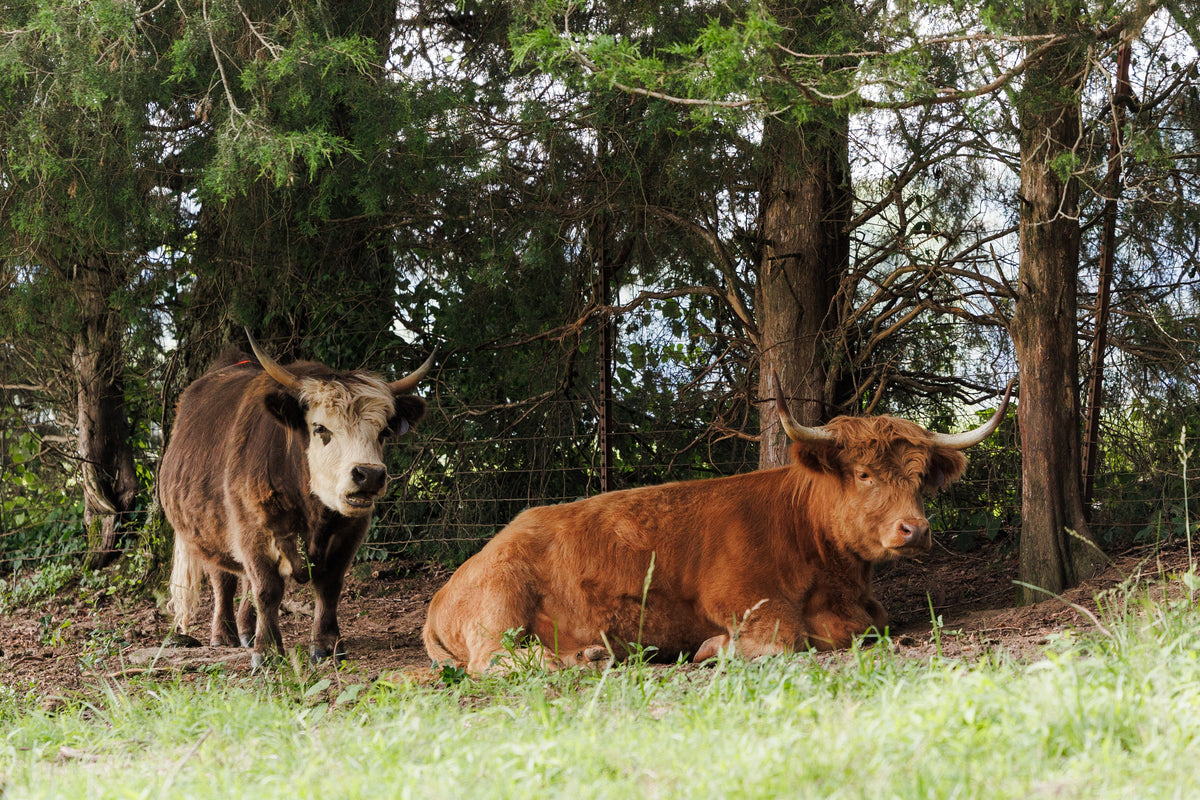
Hi y'all, Katie Van Slyke here! One of the questions I get asked the most about our mini Highland cows is whether they're actually as friendly as they look on the internet.
With eight mini Highland girls in our herd at Running Springs and a steady stream of new fans falling in love with them every day, I want to give y'all the honest answer.
Today, I'll walk through what Highland cow temperament is really like, how individual personalities can vary, how to make a Highland cow friendlier, what safety looks like around those horns, and where you can safely meet one in person. Stick with me.
Quick Answer: Are Highland Cows Friendly?
Yes, Highland cows are generally friendly, docile, and curious — one of the calmest cattle breeds in the world. Many enjoy being scratched and brushed, and most will walk up to a fence to check out a new visitor. They are still large livestock with long, sharp horns, so they are safest to interact with when you know the animal, you respect their space, and you follow basic safety rules around horns and protective mothers.
Why Highland Cows Have a Gentle Reputation
Highland cattle have been earning their "gentle giant" reputation for centuries. The breed developed in the rugged Scottish Highlands, where survival required a calm, low-stress temperament that could handle harsh weather, sparse grazing, and tight-knit herd life.
According to The Livestock Conservancy, Highlands are widely described as docile and well-suited to keepers ranging from novice to experienced.
That docile foundation is genetic. Even when handled minimally, most Highlands will not be as flighty or reactive as a beef breed bred for production speed. Add in their famous curiosity, and you get a cow that often chooses to come investigate you instead of running the other way.
That's a big part of why Highland farm tours and "coo experiences" have exploded in popularity, especially in Scotland and increasingly across the United States.
Their friendly reputation, though, is just a starting point. The temperament you actually get depends on how each individual was raised.
Highland Cow Personality Traits to Expect
Across the breed, here are the personality traits that show up again and again, especially in well-handled Highlands:
- Curious and people-aware. Highlands are notoriously nosy. They will walk up to the fence to check out new visitors, sniff hats and hands, and watch every move you make.
- Calm and low-drama. They are less reactive than most "hot" beef or dairy breeds. Loud noises, new people, and unfamiliar objects rarely send them into a panic.
- Routine-loving. They learn schedules quickly — feeding times, gate routines, daily visits. Predictability builds confidence and lowers stress.
- Smart and observant. Highlands recognize faces, voices, and patterns. The girls at Running Springs absolutely know my voice from the other side of the pasture.
- Bonded in herd life. A Highland herd, called a fold, has clear social dynamics. Most cows will not be at their best if separated from herd mates for too long.
- Strong mothers. A Highland cow with a newborn calf will be calm with people she knows and intensely protective against anyone she doesn't. Always respect a fresh mama.
Within those breed traits, every individual is still herself. Some Highlands are bold and outgoing; others are more reserved and prefer to keep a polite distance. Both are normal.
Inside Our Mini Highland Herd at Running Springs
We currently have eight mini Highland girls at Running Springs — Poppy, Petunia, Pumpkin, Posie, Peanut, Pearl, Pepper, and Pippa. Poppy and Petunia were the originals, and the "P" crew has grown from there. They are all halter-trained and handled every day, which is the single biggest factor in how friendly they feel.
Even within a herd of eight raised the exact same way, the personalities are not identical. Some of the girls will walk straight up to a brush or a scratch. Others want to know you a minute before they come in for contact. Posie is our one naturally polled girl — born without horns — and her temperament has nothing to do with that. She is one of our group just like the rest.
The biggest myth I want to break is that you can buy a "friendly Highland" the way you would buy a finished car. Friendliness with Highlands is something you build with time, not something you pick up at delivery. Owning mini Highland cows day to day is a daily relationship — quiet visits, treats, brushing, talking to them when you walk through. That investment is what turns a curious Highland into a cow who calls you over.
The "P" crew lives on across our mini cow merch collection — Poppy, Petunia, and the rest of the girls inspiring the designs.
Are Mini Highland Cows Friendlier Than Standard Highlands?

This comes up constantly, and the honest answer is: not really, but kind of. Mini Highlands share the same breed temperament as their full-sized cousins. The genetics for docile, curious, and calm are right there in both. So at a personality level, a mini and a standard should be equally friendly.
Where minis pull ahead in practice is in how easy they are to socialize. A mature mini Highland weighs roughly 500 to 800 pounds. A standard Highland cow can weigh 1,100 to 1,300 pounds, and bulls go heavier. That size difference changes everything about how much hands-on time the owner can realistically spend with each animal. Halter work, hoof trims, brushing — all of it is more doable with a 600-pound cow than with a 1,300-pound one.
So minis are not friendlier by breeding. They are friendlier by access. We can spend more time with each of our eight girls because they are smaller, more manageable, and easier to halter-train and lead. For a deeper dive on size differences, our piece on mini Highland vs regular Highland goes into all the details.
How to Make a Highland Cow Friendlier
If you already own a Highland cow and want to build a stronger relationship, or if you are picking out a mini Highland calf, here is the trust-building approach we use at Running Springs:
Start when they're young
Calves who are gently handled from the first weeks of life grow up trusting humans. Daily exposure to brushing, halter, and quiet hands turns the experience of being touched into a normal part of life.
Be consistent
Same time, same routine, same calm voice. Highlands are routine-oriented, and a cow who can predict you is a cow who relaxes around you. Random, inconsistent handling is what creates suspicion.
Use treats sparingly
A small handful of grain or a piece of carrot is a strong reinforcer of "this human is safe and good." But do not overdo treats. Too many sugary or rich treats can cause weight gain and health issues. Reserve treats for rewarding calm behavior, not as the main reason to be near you.
Brushing is the secret weapon
Highlands have a thick, shaggy double coat that genuinely feels good to have brushed, especially when shedding their winter coat in spring. A steady brushing session is one of the fastest ways to build trust with a Highland because it feels good to them.
Hand-feed when appropriate
Hand-feeding hay or treats lets the cow choose to come to you. Choice is huge with prey animals — being chosen, instead of cornered, is what builds confidence.
Respect their no
If a Highland walks away, let her. Forcing interaction sets you back. Patience with Highlands pays off, often within weeks. We have had girls come around dramatically just by us never pushing the issue.
What Affects a Highland Cow's Temperament
Even within the friendliest breed, individual temperament is shaped by several factors:
| Factor | How it affects friendliness |
|---|---|
| Genetics | Some bloodlines and individuals are calmer than others, even within the breed. Reputable breeders factor temperament into their selection. |
| Early socialization | Calves handled gently from a young age grow up trusting people. Calves raised with minimal contact are more skittish as adults. |
| Maternal status | A cow with a brand-new calf can be intensely protective and act very differently than her usual self for a few weeks postpartum. |
| Age | Younger Highlands tend to be more playful and curious. Older cows are often more settled and selective about who they engage with. |
| Environment | A new property, an unfamiliar herd, or sudden routine changes can make any Highland temporarily less approachable. Give them time to settle. |
| Handling history | A Highland who has been rushed, cornered, or roughly handled will be slower to trust again, even if her new owners are calm and gentle. |
Are Highland Bulls Friendly?
Some Highland bulls are noticeably calmer than bulls of other breeds. But here is the clear answer: an intact bull is still a bull, no matter how mellow he looks. Even friendly Highland bulls require experienced handling, secure fencing, and a healthy respect for what 1,400 to 1,800 pounds of stallion-equivalent attitude can do.
We do not treat bulls the way we treat cows at Running Springs, and you should not either. Bulls should never be petted by the public, never handled by inexperienced people, and never approached in a paddock unless you have direct hands-on cattle handling experience. The friendliest Highland bull on earth can still hurt someone without intending to. Respect the size, the horns, and the hormones.
Safety Tips for Meeting or Owning a Highland Cow

Highlands are docile, but every safe interaction with a cow comes down to a handful of basic rules. Whether you are visiting a Highland farm, photographing one through a fence in Scotland, or about to bring a mini home, these apply:
- Move slowly and predictably. Sudden movements startle even calm cattle. Walk, do not run, around them.
- Approach from the side, never the rear. Cows have a blind spot directly behind them and can kick when startled.
- Mind the horns at all times. Even a friendly head turn can connect with a kneecap or rib if you are too close. Stay aware of horn position even when the cow is relaxed.
- Never get between a cow and her calf. Even the gentlest Highland will defend her baby with everything she has.
- Don't enter a free-roaming herd's field without the owner. Even on the famous public lands in Scotland, the general rule is to admire from a respectful distance, ideally with fencing between you.
- Let the cow choose contact. Standing still and letting her walk to you is far safer than walking up to her. Cows who feel cornered react. Cows who feel they have a choice usually relax.
- Supervise children closely. Kids move fast and unpredictably, which can startle even a friendly Highland.
- Avoid bulls unless you are trained. No exceptions.
Most Highland cow injuries are not from aggression. They are accidental — a swinging head connecting with a face, a hoof landing on a foot, or a person getting bumped during play. Most of these are preventable with simple awareness.
Daily farm life behind every "P" girl on the farm shows up in our Classic Apparel collection — for the people who know that barn life is the real life.
Where to Safely Meet a Highland Cow
If you don't own one but want a real-life Highland cow encounter, the safest, most reliable way is through a structured farm experience where the animals are trained for hands-on visits and the owner is there to guide you.
Mini Highland petting farms in the US
Mini Highland farms across the country offer scheduled visits, brushing sessions, and educational tours with trained, halter-broken cows. These experiences are usually safer than encountering wild or free-roaming Highlands because the animals are specifically socialized for public interaction.
Scottish coo tours
In Scotland, there are dedicated agritourism farms that offer hands-on Highland cow experiences. The cows are bred and raised for the role and the staff manage every interaction.
Public-land Highlands in Scotland
You can see free-roaming Highlands on parts of the Scottish countryside, but the rule there is the same as anywhere else — admire from a respectful distance, do not enter a field with cattle in it without permission, and never approach a cow with calves at her side.
Following along online
If you just want to watch Highland personalities up close, social media is a wonderful free option. I share our girls almost daily on YouTube, TikTok, Facebook, and Instagram. There are also great Highland farms across both the US and UK doing the same thing.
Shop Running Springs
If you love these girls as much as we do, our shop is the next best thing to scratching one yourself. Our mini cow collection is built around Poppy, Petunia, and the rest of the herd, our Classic Apparel covers the everyday farm life behind the videos, and our full catalog has something for every animal lover.
Shop All Running Springs Merch
Are Highland Cows Friendly? The Honest Bottom Line
Yes — Highland cows are some of the friendliest, calmest, most curious cattle you will ever meet. They are smart, they recognize the people who love them, and many of them will come trotting up to a fence the second they see you walking out. But friendly does not mean tame, and it does not mean safe to walk up to on a stranger's land. The friendliest cow on the planet is still a thousand-pound animal with a horn span you would not want to be on the wrong side of.
If you are thinking about adding a Highland to your farm, build the relationship slowly, handle her every day, and respect that she is the one deciding how close she wants to be. If you are visiting Highlands somewhere, let the owner guide you, let the cow come to you, and enjoy the experience for what it is — getting to be near one of the most quietly magical farm animals on earth.
Frequently Asked Questions About Highland Cow Friendliness
Are Highland cows friendly to humans?
Yes, Highland cows are generally one of the friendliest and most docile cattle breeds. They are curious, people-aware, and often happy to be scratched or brushed once they trust you. That said, every individual cow has her own personality. Some are bold and outgoing, others are more reserved. Friendliness also depends on how the cow was raised and handled from a young age.
Are Highland cows safe to be around?
Highland cows are docile by breed standard, but they are still large livestock with long, sharp horns. They are safest to interact with when you know the animal, the handler is present, and you are respecting basic safety rules — move slowly, do not get between a cow and her calf, do not enter a free-roaming herd without the owner, and stay mindful of the horns at all times.
Can you pet a Highland cow?
Yes, you can pet many Highland cows, especially those raised with daily gentle handling. Their thick double coat makes scratches and brushing feel great to them. Always ask the owner first, approach slowly from the side, and let the cow decide whether to come in for contact. Never force interaction or reach over the horns.
Are mini Highland cows friendlier than standard Highlands?
Mini Highlands share the same breed temperament as standard Highlands. They are not inherently friendlier, but they are easier to halter-train, handle, and socialize because of their smaller size. Many people perceive minis as friendlier mostly because owners can spend more hands-on time with them, which builds trust faster.
Are Highland bulls friendly?
Some Highland bulls are calmer than bulls of other breeds, but any intact bull is still a bull. They require experienced handling, secure fencing, and respect at all times. Never treat a bull as a pet, no matter how friendly he seems, and never enter a paddock with a bull unless you have direct experience with cattle handling.
What makes a Highland cow more friendly?
Friendliness in Highland cows is shaped by three main things — genetics (the breed is naturally docile), early socialization (calves handled gently from a young age trust humans more), and consistent daily handling (predictable, calm routines build long-term trust). Treats and scratches help reinforce positive interactions.
How do I make my Highland cow friendlier?
Daily quiet visits at the same time each day, hand-feeding small treats, gentle brushing, and respecting their personal space all build trust over time. Halter training when they are young makes vet visits and hoof trims much easier later. Never use force or fast movements. Highlands respond best to patient, consistent handling.
Sources
Breed temperament, behavior characteristics, and safety guidance referenced in this article come from the following Highland cattle authorities, plus our own first-hand experience raising mini Highlands at Running Springs.
About the Author

Hi, I am Katie Van Slyke!
I breed AQHA Quarter Horses at my family farm in Tennessee, stand two stallions, and document foaling season every year from the barn floor while sharing the daily realities of farm life with a herd that includes eight mini Highland girls.
I am incredibly lucky to share this journey with millions of friends across YouTube, TikTok, Facebook, and Instagram. You can read the full story of how it all started on my about page.











0 comments