
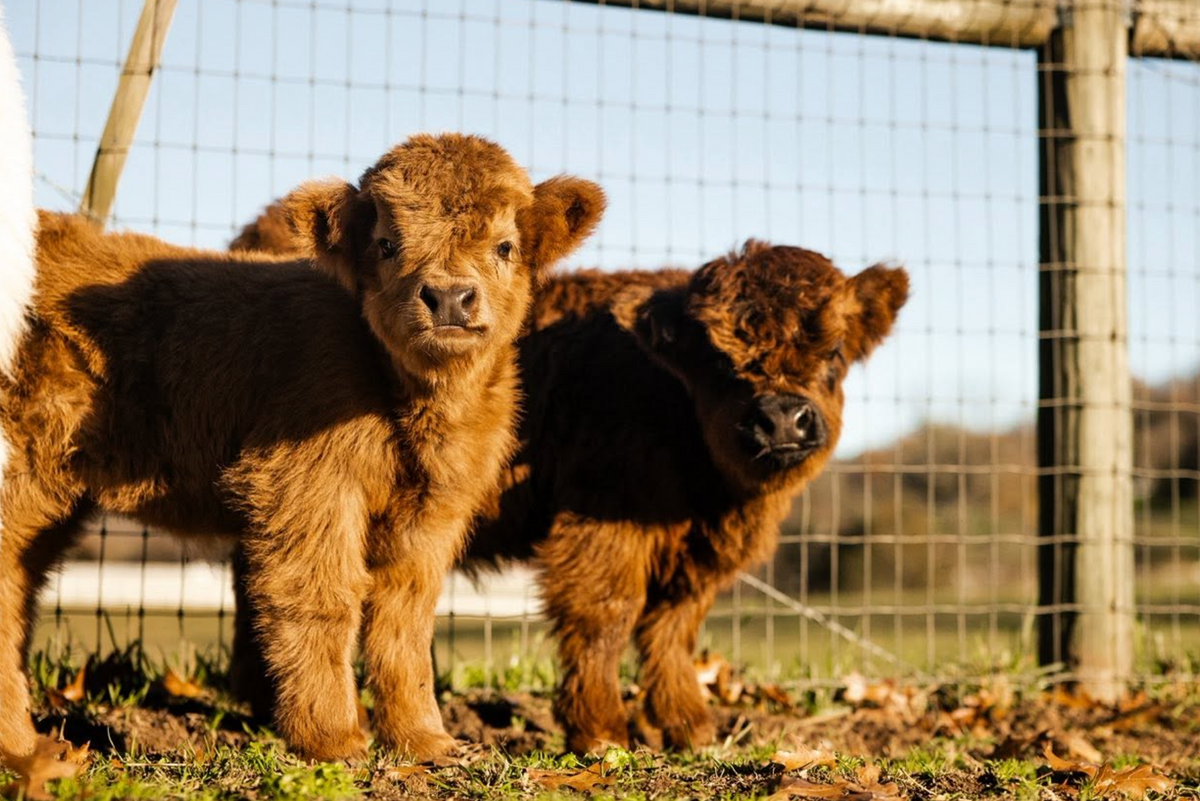
If you've seen our mini cows on TikTok or Instagram, the first question is almost always the same: just how big do they actually get? It's a fair question, and a more complicated one than most people realize.
There's a lot of conflicting information out there, partly because the "mini Highland" label gets used loosely, and partly because young calves are a lot smaller than they'll be at maturity.
Here's the straight answer, broken down by size category, plus everything I wish more breeders explained up front. If you're thinking about adding one to your farm, this is for you.
Key Takeaways
- Mature mini Highland cattle generally stand 36 to 48 inches at the rear hip and weigh about 400 to 800 pounds.
- Final size depends on category, sex, genetics, and mature parent measurements; a calf photo cannot prove adult size.
- Mini Highlands commonly live 15 to 20 years or longer with appropriate care, so ownership is a long-term commitment.
- Buyers should verify registration, mature parent heights, health records, and chondrodysplasia testing before purchasing.
What's In Here
- Mini Highland Cow Size at a Glance
- Mini Highland vs Standard Highland: A Real Size Comparison
- Bulls vs Cows vs Steers: Does Sex Affect Mini Highland Size?
- How Fast Do Mini Highland Cows Grow?
- What Is a "Micro" Mini Highland, and Are They Safe?
- How Much Land and Feed Does a Mini Highland Need?
- How Long Do Mini Highland Cows Live?
- How to Buy a Mini Highland (Without Getting Burned)
- What Mini Highland Cows Look Like in Real Life
- Meet the Herd at Running Springs
- The Bottom Line on Mini Highland Cow Size
- Frequently Asked Questions About Mini Highland Cow Size
Mini Highland Cow Size at a Glance

Mature mini Highland cattle generally stand between 36 and 48 inches tall at the rear hip and weigh between 400 and 800 pounds.
They're divided into three size categories based on adult height. According to the International Miniature Cattle Breeders Registry (IMCBR), miniature cattle are classified as 48 inches or under at the rear hip at three years of age, with sub-categories for micro and mini.
| Size Category | Height at Rear Hip | Typical Mature Weight |
|---|---|---|
| Micro Mini | 36 inches and under | 400 to 600 lbs |
| Mini | Over 36 to under 42 inches | 500 to 700 lbs |
| Mid-Size Mini | 42 to 48 inches | 600 to 800 lbs |
| Standard Highland | Over 48 inches | 900 to 2,000 lbs |
Weight ranges are estimates based on owner experience across the breed because there is no universal published weight standard for miniature Highlands the way there is for standards.
Standard Highland weights come from the American Highland Cattle Association and Oklahoma State University.
Mini Highland vs Standard Highland: A Real Size Comparison

To put it in perspective, a standard Highland cow can weigh more than twice what a mid-size mini weighs and twice as much as a small mini.
The American Highland Cattle Association reports that mature standard Highland cows average 900 to 1,200 pounds. Oklahoma State University notes mature standard Highland bulls can reach 1,800 pounds in breeding condition.
| Comparison | Mid-Size Mini Highland Cow | Standard Highland Cow |
|---|---|---|
| Mature height (hip) | 42 to 48 inches | Over 48 inches |
| Mature weight | 600 to 800 lbs | 900 to 1,200 lbs |
| Bull mature weight | Approx. 800 to 1,000 lbs | 1,500 to 2,000 lbs |
| Acres per animal (rough) | 0.5 to 1 acre | 1 to 2 acres |
| Daily forage intake | Approx. 12 to 20 lbs/day | Approx. 20 to 30 lbs/day |
The land and feed numbers are general planning estimates that vary significantly by region, soil quality, rainfall, and pasture management.
Cool, wet climates with rich grass will support more animals per acre than dry rangeland will. Always confirm with your local agricultural extension office.
If you're comparing breeds as well as sizes, our mini Highland and mini Hereford comparison is a useful next read.
Bulls vs Cows vs Steers: Does Sex Affect Mini Highland Size?
Yes, and it's something most size charts skip. In general:
- Bulls mature slightly taller and noticeably heavier than cows of the same frame score. A mid-size mini bull can outweigh a mid-size mini cow by 100 to 200 pounds.
- Cows are the most commonly purchased mini Highland because they tend to be smaller, calmer, and don't require the management considerations bulls do.
- Steers (castrated males) usually grow somewhere between bulls and cows in mature size. They make great pet or beef animals and stay manageable as they mature.
If you're buying a mini Highland and stated height is the deciding factor, ask the breeder for the sex of the parents and their measured mature heights, not just the calf's current size.
How Fast Do Mini Highland Cows Grow?

Highland cattle, including miniatures, mature more slowly than most beef breeds. Highlands typically reach their full mature body mass between 4 and 5 years of age. That's a year or two longer than commercial breeds.
Here's a rough growth timeline based on our experience and what's typical for the breed:
| Age | What to Expect |
|---|---|
| Birth | 40 to 60 lbs, around 24 inches tall |
| 6 months | Weaning age; roughly 200 to 300 lbs |
| 1 year | Yearling; still growing rapidly |
| 2 years | Close to mature height but still filling out |
| 3 years | Generally reach final adult height (this is when IMCBR confirms size classification) |
| 4 to 5 years | Reach full mature body mass and composition |
What Is a "Micro" Mini Highland, and Are They Safe?
This is the part most articles dance around. A micro mini Highland (36 inches or under) is the smallest official size category, and it's also the one buyers should research most carefully. Here's why.
True miniature cattle are created in two ways: by selective breeding for smaller frame size over many generations, or by crossing in the chondrodysplasia gene (often shortened to "chondro").
Chondrodysplasia is a form of dwarfism originally documented in Dexter cattle that produces short legs and a smaller overall body.
The problem? Chondrodysplasia is what veterinarians call an "incompletely dominant" lethal gene. According to UC Davis Veterinary Genetics Laboratory, when two carriers are bred together, roughly 25% of resulting calves will be affected by "bulldog dwarfism," a fatal condition where calves are aborted around the seventh month of gestation or are severely deformed and die shortly after birth.
Affected calves have severe disproportionate dwarfism, a short vertebral column, and a large domed head.
The Merck Veterinary Manual confirms that bulldog calf syndrome is a lethal congenital condition in cattle, and the bulldog dwarfism gene has been documented in miniature Scottish Highland cattle that carry Dexter ancestry.
UC Davis specifically lists "Miniature Scottish Highland" among the breeds appropriate for chondro testing.
How Much Land and Feed Does a Mini Highland Need?

One of the biggest reasons people go for minis is the smaller footprint. They genuinely require less space and forage than standard Highlands, though the full cost of owning a mini cow includes much more than feed.
Land Requirements
As a general planning rule, plan on 0.5 to 1 acre per mini Highland on good-quality pasture, compared to 1 to 2 acres for standard Highlands. That said, this varies a lot by climate and forage quality. If you're in a dry region or have poor soil, you'll need more land per animal. Your local USDA extension office can give you a much more accurate number for your specific area.
You should also never plan on just one. Cattle are herd animals and need at least one buddy to be healthy and happy. Two minis on 1 to 2 acres is a reasonable starting point for many small homesteads.
Feed and Hay
A mature mini Highland weighing 600 to 800 pounds eats roughly 12 to 20 pounds of dry-matter forage per day. That's about half of what a standard Highland consumes. Quality hay or pasture should make up at least 90% of their diet, with mineral supplements, fresh water, and very limited grain (if any) rounding it out.
Highlands are excellent foragers and "thrifty" eaters. They evolved to thrive on rough Scottish hillside grasses, so they actually do better on moderate pasture than on rich, lush, sugar-heavy grass that can lead to weight gain and metabolic issues.
How Long Do Mini Highland Cows Live?
One of the best things about Highland cattle, mini or standard, is their longevity. The Livestock Conservancy describes Highlands as a long-lived breed, and standard Highlands have a documented lifespan of up to 20 years. Mini Highlands generally fall in the same range, with many living 15 to 20+ years when well-cared-for.
That's a serious time commitment. Take it from someone whose oldest minis just turned 3, these girls will be part of our farm for decades. Our mini Highland journey shows what that long-term commitment looks like in real life. Plan accordingly.
How to Buy a Mini Highland (Without Getting Burned)
The mini Highland market exploded in popularity over the past few years, and unfortunately the bandwagon brought along some questionable breeders. Here's what to look for if you're shopping:
- Verified parent heights at maturity. Ask for the mature, measured heights of the sire and dam. A calf's mature size will most closely reflect its parents' verified heights, not its current size.
- IMCBR registration. Registration with the International Miniature Cattle Breeders Registry means the animal has been documented to recognized size standards. IMCBR offers both "Temporary" and "Permanent" registration, with Permanent requiring proof of mature height at age 3+.
- Chondrodysplasia testing. Especially for micro and small mini animals, ask whether the parents have been DNA tested. UC Davis and other labs offer chondro testing.
- Realistic expectations. A 6-month-old calf labeled "micro" by a breeder is a projection, not a guarantee. Real classification happens at age 3+.
- Photos of mature animals from the breeder's lineage. If a breeder only shows you calf photos, you don't have enough info.
What Mini Highland Cows Look Like in Real Life

Our mini cows at Running Springs are mid-size minis. Poppy and Petunia, our oldest, are 3-year-olds and pretty much at their adult height.
Pumpkin and Posie are our 2-year-old "extra spicy" pair, and our yearlings Peanut, Pearl, and Pepper round out the bunch alongside Pippa, our newest addition who came to us as a Christmas gift to my mom.
What I'll tell you is this: even at mid-size mini sizes, these are still livestock. They have horns. They have opinions. They have hooves and coats that need regular care. They aren't pets the way a goat or a dog is a pet.
But they are absolutely the most rewarding animals on our farm, and the moment you see one for the first time, you'll understand why they took the internet by storm.
Meet the Herd at Running Springs
Running Springs is our family farm in Nolensville, Tennessee. We raise miniature Highland cattle, Simmental cattle, quarter horses, mini horses, mini donkeys, Nigerian dwarf goats, and a whole lot of personality in between.
Our miniature Highland girls (Poppy and Petunia, Pumpkin, Posie, Peanut, Pearl, Pepper, and Pippa) are the stars of a lot of our social content, and you can watch them in action across our channels. You can also read how mini cow breeding began at Running Springs.
If you want more from the farm, come follow along on Facebook, Instagram, TikTok, and YouTube. And if you want to take a piece of the herd home with you, our mini cow merch collection features designs inspired by Poppy, Petunia, and the rest of the "P" crew.
The Bottom Line on Mini Highland Cow Size
At the end of the day, mini Highland cows stand 36 to 48 inches at the rear hip and weigh between 400 and 800 pounds at full maturity. That's the answer in one sentence.
The longer answer, the one I wish more breeders shared up front, is that size depends on the specific size category (micro, mini, or mid-size), the sex of the animal, the genetics of the parents, and whether the chondrodysplasia gene is in the mix.
If you're considering a mini Highland for your farm, focus on verified parent heights, IMCBR-registered animals, and a breeder who is transparent about chondro testing.
Plan for 15 to 20+ years together. Do that, and you'll have one of the most rewarding additions to your farm. That's exactly what Poppy, Petunia, and the rest of the "P" crew have been for us at Running Springs.
Frequently Asked Questions About Mini Highland Cow Size
How tall is a full-grown mini Highland cow?
A full-grown mini Highland cow stands between 36 and 48 inches at the rear hip, depending on size category. Micros are 36 inches and under, minis are 36 to 42 inches, and mid-size minis are 42 to 48 inches. The International Miniature Cattle Breeders Registry confirms final size classification at age 3.
How much does a mini Highland cow weigh?
Mature mini Highland cows generally weigh between 400 and 800 pounds, depending on their size category and sex. Micro minis tend to be on the lighter end (400 to 600 lbs), while mid-size minis run 600 to 800 lbs. Bulls weigh more than cows of the same frame.
What's the difference between a mini and a micro Highland?
The difference is primarily mature height at the rear hip. Micro minis are 36 inches or shorter at maturity, while standard minis are over 36 inches but under 42 inches. Micros are often produced using the chondrodysplasia (dwarfism) gene, which is a serious health consideration because two carriers bred together can produce stillborn "bulldog" calves.
At what age does a mini Highland reach full size?
Mini Highlands generally reach their final adult height around 3 years of age, which is when registries like IMCBR confirm their size classification. They continue to fill out and add muscle mass until around 4 to 5 years of age. Calf size is not a reliable predictor of adult size.
How much land does a mini Highland cow need?
Plan on roughly 0.5 to 1 acre per mini Highland on well-managed pasture in temperate climates. This is about half of what a standard Highland needs. The actual number depends on your climate, soil quality, and pasture management. Your local USDA agricultural extension office can give you the most accurate estimate for your area.
Can mini Highland cows live with other animals?
Yes, but they still need at least one other cow to be truly happy. Cattle are herd animals. They can share pasture with horses, donkeys, goats, or sheep, but a single mini Highland kept without another bovine companion is more likely to be stressed and harder to manage. We house ours together in their own dedicated pasture.
About the Author

Hi, I am Katie Van Slyke, and I share my daily life at Running Springs farm with millions of wonderful people online. I am best known for raising a huge variety of animals, from Quarter horses to famous mini Highland cows.
I am incredibly lucky to share this journey with millions of friends across YouTube, TikTok, Facebook, and Instagram. You can read the full story of how it all started on my about page.
Sources
Size, weight, breed, and health facts in this article are sourced from the following. Land and feed planning numbers vary by region and should be confirmed with your local USDA agricultural extension office. Personal observations come from our own experience raising mini Highland cattle at Running Springs.
- International Miniature Cattle Breeders Registry (IMCBR)
- American Highland Cattle Association — The Breed
- Oklahoma State University — Canadian Highland Cattle
- The Livestock Conservancy — Highland Cattle
- UC Davis Veterinary Genetics Laboratory — Bulldog Dwarfism
- Merck Veterinary Manual — Congenital Anomalies in Cattle













1 comment
Highland Cows are soooo BEAUTIFUL, I just love them soooo much. I wish I could of had one but West Seneca New York does not allow are town to have one.. It would have been sooo kool to have a highland Cow for a pet!!!!! Have him or her in the parlor with you watching tv, That would be fun!!!!!