
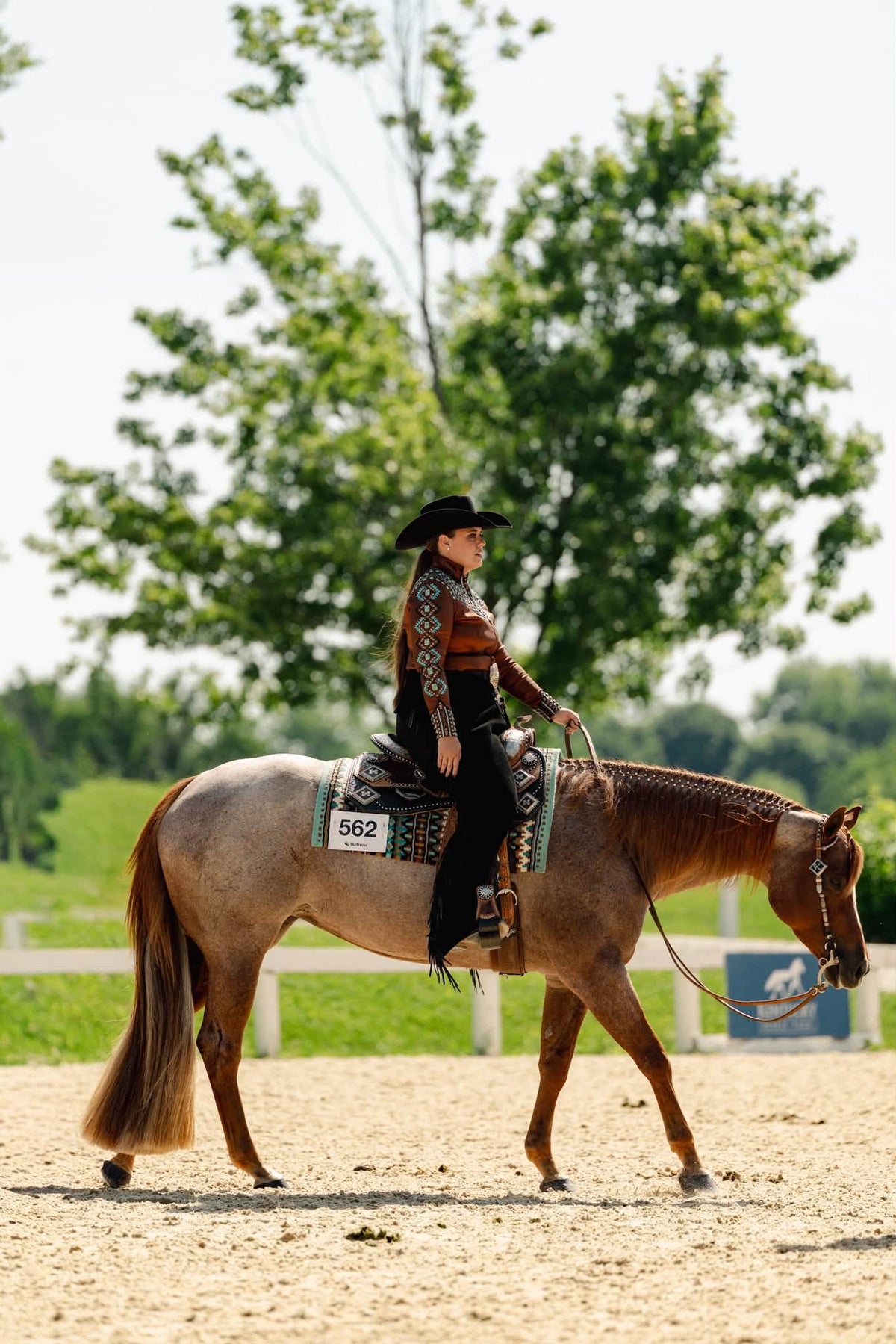
AQHA rules are the official guidelines set by the American Quarter Horse Association that govern how Quarter Horses are shown, bred, and registered. They exist to keep competition fair and to protect the horses, and they cover everything from how each show class is judged and what equipment is allowed, to stallion testing and how you name and register a new foal. All of it lives in the AQHA Rulebook, which is free to read online and updated often.
I show on the AQHA all-around circuit and register every foal born at Running Springs under these rules, so the rulebook is not background reading for me. It is the framework I live and compete inside every season.
If you are new to the Quarter Horse world, the rulebook can feel like a lot. So let's break the AQHA rules down into plain English: what they cover, who has to follow them, the big show and breeding rules, and the recent change to the well-known 2-year rule that a lot of people are asking about.
Key Takeaways
- AQHA rules govern showing, breeding, and registering American Quarter Horses, and they are published in the official AQHA Rulebook.
- The rulebook is free to read on aqha.com and through the AQHA app, and it is updated regularly, so always check the current version.
- Show rules cover class-by-class judging, allowed and prohibited equipment, and horse welfare and medication limits.
- AQHA horsemanship is a core class that judges the rider, not the horse.
- The AQHA World Show is the association's championship event, and horses must qualify to compete there.
- The AQHA 2-year rule was removed at the 2026 AQHA Convention in Las Vegas.
What Are AQHA Rules?

The American Quarter Horse Association is the world's largest breed registry, and it is the body that governs showing, breeding, and registering Quarter Horses. Its rules are designed to do two things above all: promote fair competition and protect the welfare of the horses.
Every AQHA member and exhibitor agrees to follow these rules. Shows work a little differently: show management applies for AQHA approval on a voluntary basis, and by doing so they agree to run the show according to AQHA rules. That is how a horse show anywhere in the country can be counted as an official AQHA event with results that count toward records and awards.
If you are just getting started with horses in general, my post on beginner riding lessons is a gentle place to begin before you ever step into a show pen.
AQHA Show Rules: Classes, Judging, and Equipment
The biggest chunk of the rulebook covers showing. Each class has its own rules for how it is judged and what tack and equipment you can and cannot use. Some equipment is prohibited outright, and there are strict limits on medications to keep competition fair and horses healthy.
I show all-around, which means at a single show I might go from western pleasure to hunt seat equitation to showmanship to trail. So I am living in a lot of these rulebook sections at once, and I promise it becomes second nature once you learn the classes you actually compete in.
Most AQHA competition is built around a set of core classes. Here is a beginner-friendly look at what they are and what the judge is actually watching:
| Core class | What it is judged on |
|---|---|
| Western Pleasure | The horse's manners, movement, and quality of gaits under western tack |
| Western Horsemanship | The rider's body position, seat, and ability to control the horse through a pattern |
| Showmanship | The handler presenting the horse in hand, judged on precision and presentation |
| Hunter Under Saddle | The horse's movement and manners under English tack |
| Hunt Seat Equitation | The rider's English position and effectiveness |
| Trail | The horse and rider navigating obstacles cleanly and calmly |
| Ranch Riding | A horse's quality of movement and versatility doing real ranch-style work |
A helpful thing for beginners to know: AQHA runs a leveling program that groups exhibitors by experience, so newcomers are not thrown straight in against seasoned pros. It is one of the friendliest on-ramps into the show world. You can see what a real show day looks like in my recap of a day of western pleasure with Denver.
Beginner tip: Before you enter your first class, read the rulebook section for that exact class. Every class has its own tack and attire rules, and a small equipment mistake can cost you before you even trot off.
What Is AQHA Horsemanship?
AQHA horsemanship is a class that tests the rider rather than the horse. Riders in western tack follow a prescribed pattern of maneuvers at a walk, trot, or lope, and finalists often ride as a group around the arena. The judge focuses on the rider's body position, their seat in the saddle, and how quietly and precisely they control the horse.
It is one of the core AQHA classes and a favorite entry point for youth and amateur riders, because it rewards practice, patience, and correct fundamentals over having the flashiest horse. If you can sit quietly, cue softly, and ride an accurate pattern, you can be competitive in horsemanship.
Horsemanship is one of the all-around classes I show myself, and I love it for exactly that reason. A rider who puts in the work at home can walk in and shine on a good, honest horse, and there is no faking a clean pattern.
The AQHA World Show

The AQHA World Show is the association's championship event, the pinnacle of the show year where the best horses and riders in each class compete. You do not simply sign up for it. Horses and exhibitors have to qualify during the year first.
There are a few ways to qualify, and AQHA has worked to make the pathways more accessible:
- Participation method: take part in a set number of AQHA-approved events during the qualifying period and pay the standard entry fee.
- Level 1 pathway: newer exhibitors can earn invitations through AQHA Level 1 Championship shows.
- Affiliate invitee: qualify through your state or provincial AQHA affiliate.
Winning at the top level is the goal of every serious program, ours included. When Hank won three championships at the 2023 Quarter Horse Congress, that is exactly the kind of AQHA-sanctioned competition these rules make possible.
Breeding and Registration Rules
AQHA rules do not stop at the show pen. A whole section governs breeding and registration, which is how a foal earns its official papers and pedigree. In plain terms, the rules make sure a registered Quarter Horse really is what its papers say it is.
- Parentage verification: foals must have DNA testing to confirm their sire and dam before they can be fully registered.
- Stallion requirements: stallion owners have reporting and testing responsibilities, including genetic disease panels, before their foals can be registered.
- Naming rules: registered names have length limits and cannot duplicate existing names, which is why breeders get creative. Every foal born on our farm carries the "RS" prefix.
Our cornerstone stallion VS Code Red sires many of our foals, and we use tools like embryo transfer and recipient mares within these rules.
I broke down how that works in my post on the vital role of recipient mares. You can also see how the naming rules play out in our herd roundup of registered names.
What Is the AQHA 2-Year Rule?
This is the rule everyone is asking about right now, so let's clear it up. The AQHA 2-year rule was a breeding regulation adopted in 2015. In simple terms, it said that frozen semen from a stallion, or frozen embryos from a mare, could not be used to produce an AQHA-registrable foal more than two calendar years after that horse died, was gelded, or was sterilized. It applied to horses foaled in 2015 or later, so genetics from many older, influential stallions were not affected.
Supporters said the rule encouraged genetic diversity and kept a handful of popular horses from dominating the breed's future through frozen genetics. Opponents felt it unfairly restricted younger stallions and modern breeding programs.
As a breeder, I keep a close eye on rules like this one, because they shape the real decisions we make in the barn every breeding season.
Important update: During the 2026 AQHA Convention in Las Vegas, members and the Board of Directors voted to remove the 2-year rule. So while you will still see it discussed everywhere, the restriction itself has been rescinded. Always confirm the current rulebook, because this is exactly the kind of thing that changes.
If you are shopping for a registered horse and want to understand what its papers mean, our horse and cattle sales page is a good window into how a real program presents its horses.
AQHA Rules Change Often: How to Stay Current
Here is the single most important thing for any beginner to understand: AQHA rules are not set in stone. The association continually updates its policies on show requirements, breeding, and medication, usually through votes at the annual AQHA Convention and periodic rule changes in between.
The 2-year rule repeal is one recent example. Another is a 2026 update to AQHA's rules around dexamethasone, a common medication, which shows just how specific and current these rules get. That is why the official, searchable AQHA Rulebook is the only source you should trust for a final answer. It is free on aqha.com and available as an app, and it is the version I check before every season.
Show season means early mornings and long days at the ring. My Katie's Classics line is what I live in from the barn to the back gate.
AQHA Life at Running Springs

Running Springs is our family farm in Nolensville, Tennessee, and AQHA rules shape our whole year, from the classes I train for to the way we register every foal. We breed, raise, show, and sell registered American Quarter Horses, so following these rules correctly is part of doing right by our horses and the people who buy them.
If you want to see the full menagerie behind the show string, take a peek at how many animals we have. And come follow along on Facebook, Instagram, TikTok, and YouTube.
The Bottom Line on AQHA Rules
AQHA rules can look intimidating from the outside, but at their heart they are simple: keep competition fair and keep horses safe and honestly represented. Learn the rules for your specific class, understand the basics of registration if you are breeding or buying, and always check the current rulebook, because things like the 2-year rule really do change.
You do not have to memorize the whole book to get started. Learn the parts that apply to what you are doing, lean on the leveling program if you are new, and enjoy the ride. That is exactly how I started, and now these rules are simply part of daily life at Running Springs.
Frequently Asked Questions
What are AQHA rules?
AQHA rules are the official guidelines from the American Quarter Horse Association that govern how Quarter Horses are shown, bred, and registered. They cover class-by-class judging, allowed and prohibited equipment, medication limits, stallion testing, and foal registration. All of it is published in the AQHA Rulebook, which is free to read on aqha.com and updated regularly.
What is the AQHA 2-year rule?
The AQHA 2-year rule was a breeding regulation adopted in 2015 that stopped frozen semen or embryos from being used to produce an AQHA-registrable foal more than two calendar years after the horse died, was gelded, or was sterilized, for horses foaled in 2015 or later. It was removed at the 2026 AQHA Convention in Las Vegas, so the restriction no longer applies. Always confirm the current rulebook.
What is AQHA horsemanship?
AQHA horsemanship is a class that judges the rider rather than the horse. Riders in western tack complete a prescribed pattern at a walk, trot, or lope, and the judge scores their body position, seat, and how precisely they control the horse. It is a core class and a popular starting point for youth and amateur riders.
How do you qualify for the AQHA World Show?
You qualify for the AQHA World Show during the year rather than just entering. Common paths include the participation method (taking part in a set number of AQHA-approved events and paying the entry fee), earning an invitation through AQHA Level 1 Championship shows, or qualifying as a state or provincial affiliate invitee. The exact requirements are listed in the current AQHA rules.
Where can I find the AQHA rulebook?
The official AQHA Rulebook is free to read on aqha.com and is also available as an app, so you can search it from your phone at a show. Because AQHA updates its rules regularly, the online rulebook is always the most current and reliable source, and it is the version you should check before entering a class or registering a foal.
About the Author

Hi, I am Katie Van Slyke, and I share my daily life at Running Springs farm with millions of wonderful people online. I breed, raise, show, and register American Quarter Horses on the AQHA circuit, and I am best known for raising a huge variety of animals, from champion Quarter horses to famous mini Highland cows.
I am incredibly lucky to share this journey with millions of friends across YouTube, TikTok, Facebook, and Instagram. You can read the full story on my about page.
Sources
The rules and event details in this guide come from official AQHA resources and industry reporting on recent rule changes. Anything about our own program is drawn from firsthand experience at Running Springs.











0 comments